
CAT8 cable represents the cutting edge of copper Ethernet technology, but understanding its specifications requires cutting through marketing hype to evaluate whether 40Gbps speeds and 2000MHz bandwidth actually matter for your network. These cables were engineered primarily for data centers and server rooms with 25GBASE-T and 40GBASE-T requirements, not typical home or office environments where CAT6A handles most workloads at a fraction of the cost.
The specifications tell a compelling story: CAT8 supports frequencies up to 2000MHz compared to 500MHz for CAT6A, maintains this performance across 30-meter channels rather than 100 meters, and requires fully shielded construction with S/FTP or F/FTP configurations. Each twisted pair receives individual shielding plus an overall shield, minimizing crosstalk and electromagnetic interference to levels unmatched by previous ethernet cable standards.
However, specifications alone don’t determine real-world value. CAT8’s 25-30 meter distance limitation makes it impractical for residential wiring, while its rigid construction complicates installation in tight spaces. The connectors must meet stringent Category 8 component standards, and termination requires precision that exceeds typical field installation capabilities.
This guide examines CAT8’s technical specifications in detail, explaining what each metric means for actual performance, which applications genuinely benefit from these capabilities, and when investing in CAT8 makes practical sense versus simply following industry trends. Understanding these specifications empowers informed decisions rather than specification-chasing purchases.
What Makes CAT8 Different: Core Specifications Breakdown
Bandwidth and Frequency: The 2000 MHz Advantage
Bandwidth refers to the amount of data a cable can transmit simultaneously, measured in megahertz (MHz). CAT8 cables operate at 2000 MHz, representing a substantial leap from previous generations. To put this in perspective, CAT6 and CAT6A cables support 250 MHz and 500 MHz respectively, while CAT7 reaches 600 MHz. This means CAT8 provides four times the bandwidth of CAT6A and more than triple that of CAT7.
In practical terms, higher bandwidth translates to greater capacity for handling multiple data streams without interference or signal degradation. Think of it as a highway: more lanes (bandwidth) allow more vehicles (data packets) to travel simultaneously without congestion. For current residential and small business applications, however, the 2000 MHz capability often exceeds what most networking equipment can utilize.
The advantage becomes relevant in specific scenarios: data centers requiring maximum throughput, server rooms with high-density connections, or future-proofing installations for upcoming technologies. For typical home networking, gaming, or streaming applications, CAT6A’s 500 MHz bandwidth already provides more than adequate headroom for 10 Gigabit Ethernet over its full 100-meter distance.
The frequency increase also requires stricter shielding requirements, which is why CAT8 mandates shielded construction throughout. This adds cost and reduces flexibility compared to unshielded alternatives that may serve most residential purposes equally well.
Speed Ratings: 25GBASE-T and 40GBASE-T Explained
Cat 8 cables support two primary speed ratings: 25GBASE-T and 40GBASE-T. These designations refer to data transmission speeds of 25 gigabits per second and 40 gigabits per second respectively. To put this in perspective, 25GBASE-T delivers speeds approximately 2.5 times faster than the 10 Gbps maximum of Cat 6a, while 40GBASE-T pushes that boundary even further.
However, these impressive speeds come with a significant caveat that often catches buyers off guard: the 30-meter distance limitation. Unlike Cat 6a cables that maintain 10 Gbps speeds up to 100 meters, Cat 8 cables can only guarantee their rated performance within 30 meters (approximately 98 feet). Beyond this distance, performance degrades substantially or requires network equipment downgrades to lower speeds.
For real-world applications, this distance restriction fundamentally shapes where Cat 8 makes practical sense. Data centers benefit most from these speeds, as equipment racks and switches typically sit well within the 30-meter range. In these environments, 40GBASE-T enables rapid server-to-server communication and high-bandwidth storage access that justifies the premium cost.
For residential or office networking, the picture changes dramatically. Most home networks operate at 1 Gbps, with high-end setups reaching 2.5 or 10 Gbps. Even if you have networking equipment capable of 25 or 40 Gbps speeds, your internet service provider connection likely tops out far below these thresholds. A typical gigabit internet connection uses less than 5 percent of Cat 8’s capacity.
Gaming enthusiasts should note that while Cat 8 handles current and near-future bandwidth demands, standard Cat 6a cables already provide more than sufficient speed for gaming, streaming, and general household use at a fraction of the cost.
Physical Construction and Shielding Requirements
Shielding Standards: S/FTP Configuration
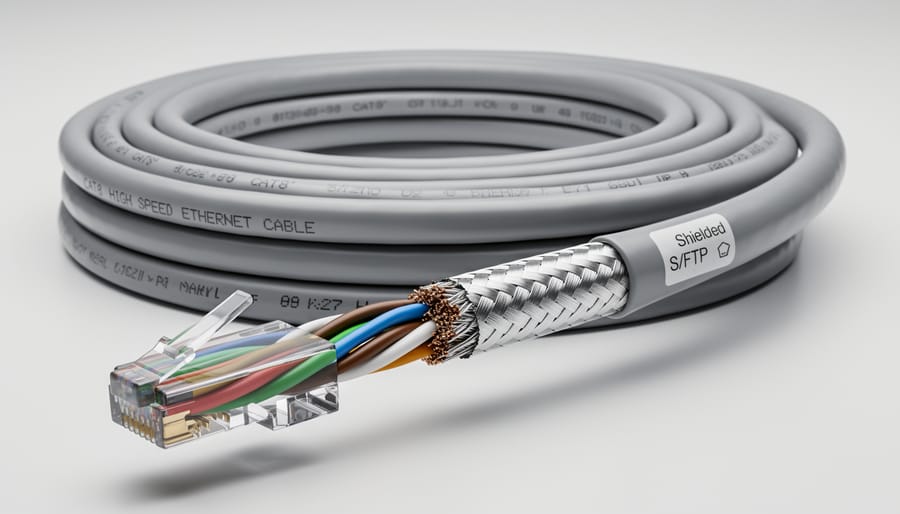
CAT8 cables employ a mandatory S/FTP (Shielded/Foiled Twisted Pair) shielding configuration, representing the most robust shielding system available in Ethernet cabling. This dual-layer protection is essential for achieving CAT8’s demanding performance targets at frequencies up to 2000 MHz.
The “F” in S/FTP refers to individual foil shields wrapping each of the four twisted pairs. This pair-level shielding prevents crosstalk between adjacent pairs within the same cable, a critical requirement when transmitting data at such high frequencies. Without this isolation, signal interference would degrade performance and make the 25 Gbps and 40 Gbps speeds impossible to achieve reliably.
The “S” designates an overall braided shield that surrounds all four shielded pairs together. This outer layer protects against external electromagnetic interference (EMI) from nearby power cables, fluorescent lights, and other electronic equipment. The braided construction provides superior coverage compared to foil-only alternatives.
This mandatory dual shielding makes CAT8 cables noticeably thicker, less flexible, and more expensive than CAT6A or lower categories. However, it’s non-negotiable for the specification. Any cable marketed as CAT8 without S/FTP shielding doesn’t meet official standards and won’t deliver certified performance. This rigorous shielding requirement explains why CAT8 excels in electrically noisy data center environments but may be unnecessary for typical residential applications.
Conductor and Connector Specifications
CAT8 cables utilize 22 to 24 AWG (American Wire Gauge) conductors, with 22 AWG being the most common specification for Ethernet applications. This thicker gauge compared to CAT6A provides improved signal integrity at higher frequencies, directly supporting CAT8’s 2000 MHz bandwidth capability.
When choosing between solid and stranded conductors, understanding the application context is essential. Solid conductors offer superior electrical performance and are the standard choice for permanent installations like in-wall runs and structured cabling systems. They maintain tighter impedance tolerances and provide better high-frequency transmission characteristics, making them ideal for maximizing CAT8’s performance potential.
Stranded conductors, featuring multiple thin wire strands twisted together, provide greater flexibility and durability under repeated bending. This makes them appropriate for patch cables connecting devices to wall jacks or switches. However, stranded cables exhibit slightly higher attenuation and may not fully leverage CAT8’s maximum distance specifications.
Connector compatibility presents a critical consideration for CAT8 deployment. While CAT8 cables physically accept standard RJ45 connectors, achieving rated performance requires specialized components. CAT8 typically employs shielded GG45 or TERA connectors, though some manufacturers offer backward-compatible shielded RJ45 connectors specifically designed for CAT8 specifications.
The shielding requirements distinguish CAT8 connectors from previous categories. Each connector must maintain continuous shielding integrity throughout the termination, typically requiring tool-assisted installation rather than simple crimping. This ensures the 360-degree shielding necessary for meeting EMI protection standards and achieving the specified 40 Gbps data rates. For residential applications where standard equipment uses RJ45 ports, verify that your CAT8 cables include appropriate shielded RJ45 connectors rather than specialized industrial connectors that may create compatibility challenges.
Official Standards: TIA and ISO Certifications
CAT8.1 vs CAT8.2: Understanding the Difference
CAT8 actually exists in two distinct standards: CAT8.1 and CAT8.2. While both deliver the same impressive 25 or 40 Gbps speeds over 30 meters, they differ in their technical specifications and regional adoption.
CAT8.1 represents the more widely adopted standard, particularly in North America. It maintains backward compatibility with existing infrastructure by supporting the same frequency ranges as CAT6A (up to 2000 MHz) and using standard RJ45 connectors. This makes CAT8.1 the practical choice for those upgrading existing networks without replacing termination hardware.
CAT8.2, predominantly used in Europe, takes a different approach. It’s designed for compatibility with proprietary connector systems like TERA and GG45, which were developed as potential RJ45 successors. While these connectors can offer superior performance characteristics, they require specialized termination equipment and aren’t compatible with standard RJ45 ports without adapters.
For most residential and small business applications, the distinction matters primarily for connector compatibility. If you’re working with standard networking equipment featuring RJ45 ports, CAT8.1 is your clear choice. CAT8.2 cables are typically reserved for specific data center environments or European installations already utilizing TERA or GG45 infrastructure.
When purchasing, always verify the connector type matches your equipment. The performance difference between the two standards is negligible in real-world applications, but using incompatible connectors will prevent your network from functioning entirely. Most consumer-facing CAT8 cables default to the CAT8.1 standard with RJ45 termination.
Certification and Testing Requirements
Authentic CAT8 cables must pass rigorous testing protocols defined by ANSI/TIA-568.2-D standards. Proper certification involves verification across multiple performance metrics, including frequency response up to 2000 MHz, return loss measurements, and crosstalk parameters at all specified frequencies. The Telecommunications Industry Association requires independent laboratory testing for official certification, meaning manufacturers cannot self-certify their products.
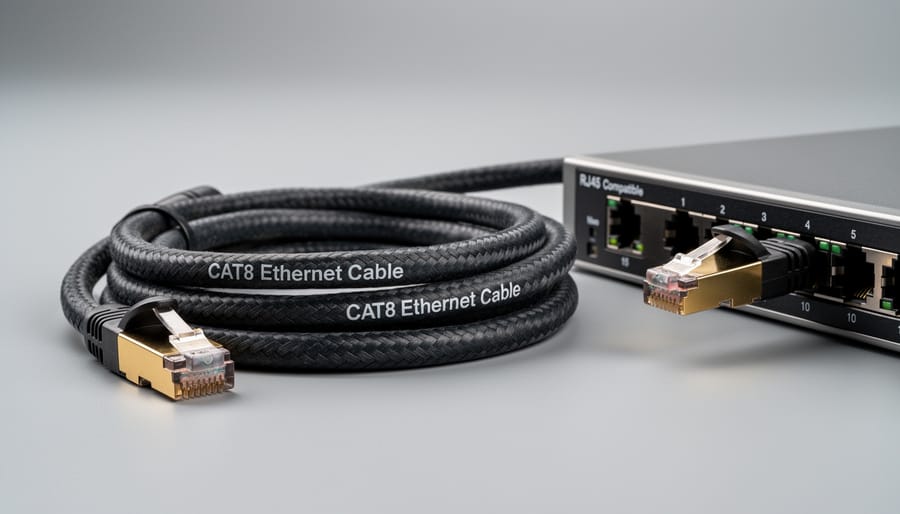
When purchasing CAT8 cables, look for clear labeling on the cable jacket itself. Certified cables display “Category 8” or “CAT8” markings alongside compliance standards like “ANSI/TIA-568.2-D” or “ISO/IEC 11801.” The jacket should also indicate shielding type—either S/FTP (shielded/foiled twisted pair) or U/FTP (unshielded/foiled twisted pair). Reputable manufacturers provide test reports and certification documentation upon request.
Beware of counterfeit cables claiming CAT8 performance without proper certification marks. Testing equipment like cable certifiers from Fluke Networks or IDEAL Networks can verify authentic specifications, though these tools represent significant investment. For most users, purchasing from established manufacturers with documented compliance history offers sufficient assurance. Remember that CAT8 certification ensures the cable meets baseline performance requirements, but installation quality equally affects real-world performance.
Distance Limitations and Why They Matter
Cat 8 cable comes with a significant constraint that often surprises buyers: a maximum channel length of just 30 meters (approximately 98 feet). This limitation isn’t arbitrary—it’s a direct consequence of the cable’s design priorities and the physics of high-frequency signal transmission.
The 30-meter restriction exists because Cat 8 operates at frequencies up to 2000 MHz, dramatically higher than Cat 6A’s 500 MHz ceiling. At these extreme frequencies, signals experience substantially greater attenuation (signal loss) and are more susceptible to electromagnetic interference. The cable’s shielding and construction mitigate these issues, but physics ultimately imposes boundaries. Beyond 30 meters, maintaining the promised 25 or 40 Gbps speeds becomes unreliable, potentially causing packet loss, retransmissions, and network instability.
This distance limitation has profound practical implications. In data center environments—where Cat 8 was specifically designed—30 meters typically provides adequate reach for top-of-rack switching and short server interconnects. A single network cabinet rarely requires longer runs, making Cat 8 an excellent choice for these controlled scenarios.
However, for residential and small office deployments, the constraint becomes problematic. Consider a typical home where the router sits in a ground-floor utility closet. Running cable to a second-floor gaming room or home office frequently exceeds 30 meters when accounting for vertical rises, wall routing, and avoiding obstacles. In these situations, Cat 6A becomes the more sensible option, offering 10 Gbps speeds over a full 100-meter distance—more than sufficient for current and near-future home networking needs.
The key takeaway: before investing in Cat 8, measure your actual cable runs carefully. If any exceed 30 meters, you’ll either need to redesign your network topology with additional switches or intermediary connection points, or simply choose a cable category better suited to longer distances. For most users outside data centers, Cat 6A provides a better balance of performance, distance capability, and cost-effectiveness.
Real-World Applications: Where CAT8 Specs Actually Matter
Data Center and Enterprise Use Cases
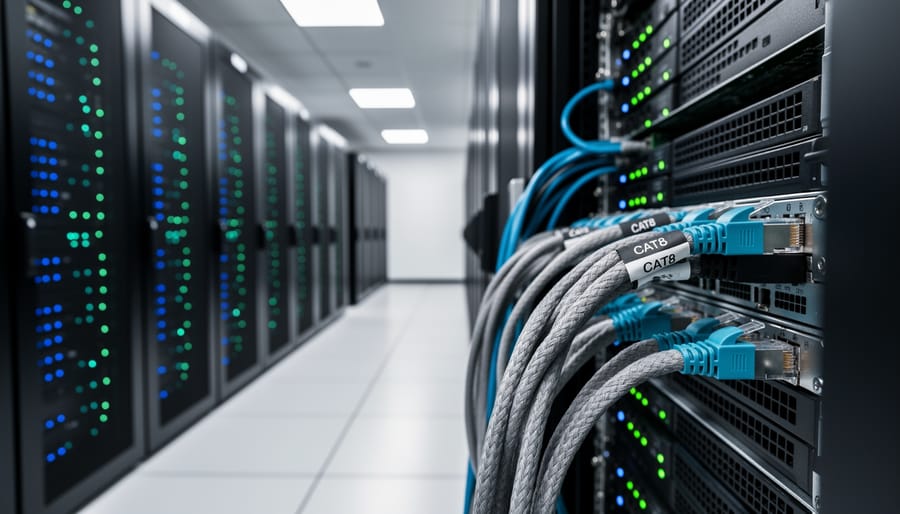
CAT8 cable truly shines in data center environments where equipment sits within close proximity and demands maximum throughput. The 30-meter distance limitation isn’t a drawback here—it’s actually ideal for top-of-rack switching configurations, server-to-switch connections, and high-density patch panel implementations.
In enterprise server rooms, CAT8 handles the explosive bandwidth requirements of 25GBASE-T and 40GBASE-T network equipment without breaking a sweat. This makes it particularly valuable for storage area networks (SANs), hyper-converged infrastructure, and virtualization hosts that push massive amounts of data between servers. The shielded construction also provides superior immunity to electromagnetic interference in environments packed with power supplies, cooling systems, and overlapping cable runs.
However, be realistic about your needs. Many data centers achieve excellent results with CAT6A for longer runs at lower costs. CAT8 makes sense when you’re building out new high-speed clusters, upgrading core infrastructure to support next-generation switches, or addressing specific interference problems in dense installations.
For small business server closets or home labs, CAT8 is typically overkill unless you’re running cutting-edge 25GbE equipment. The premium price rarely justifies the investment when CAT6A delivers 10 gigabit speeds across the same distances at a fraction of the cost.
Gaming and Home Networking: The Reality Check
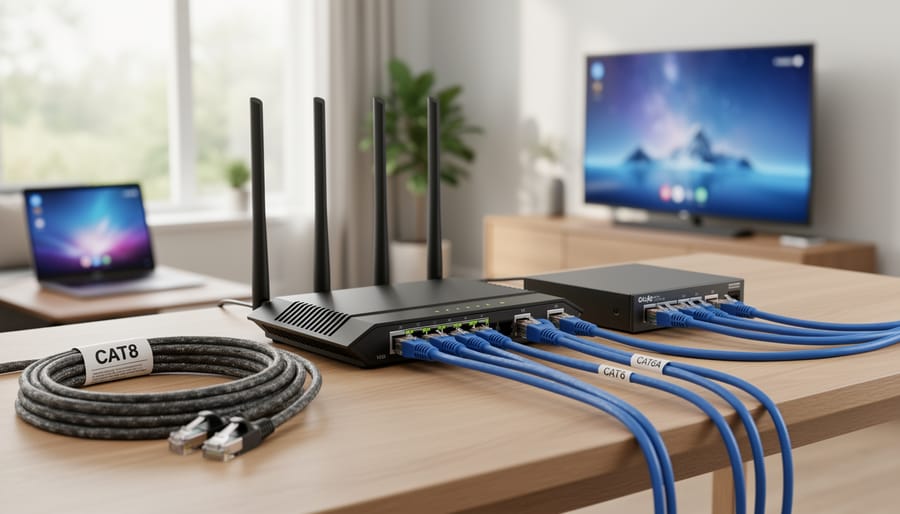
Let’s address the elephant in the room: CAT8’s impressive 40Gbps bandwidth capacity and 2000MHz frequency far exceed what most home networks can actually utilize. Current residential internet connections typically max out between 1-2Gbps, and even gigabit speeds remain uncommon in many areas. Your gaming PC, smart TV, or home NAS simply cannot leverage CAT8’s full potential.
For gaming specifically, the performance difference between CAT6A and CAT8 is negligible. Latency depends primarily on your internet service provider, router quality, and server distance rather than cable category. A quality CAT6A cable already supports 10Gbps at distances up to 100 meters, which covers virtually all home networking needs with room to spare.
The cost premium for CAT8 becomes harder to justify when CAT6A cables typically cost 40-60% less while delivering identical real-world performance for home applications. CAT8’s shielding design, while excellent for reducing interference in data centers, provides minimal benefit in residential environments where electromagnetic interference rarely impacts network performance.
Consider future-proofing realistically. By the time 40Gbps becomes relevant for home users—likely a decade or more—cable technology may evolve further, and wireless solutions could dominate. Investing in quality CAT6A infrastructure represents the sweet spot: substantial performance headroom without overspending on enterprise-grade specifications that won’t materialize into tangible benefits.
Unless you’re building a home lab mimicking data center conditions or running specialized professional equipment, CAT6A remains the more rational choice for gaming and home networking applications.
Comparing CAT8 Specifications to Other Cable Categories
Understanding how CAT8 stacks up against its predecessors is essential for making informed purchasing decisions. When comparing cable categories, the differences become immediately apparent in several key specifications.
CAT6 cables, the most common choice for residential and small business installations, support bandwidth up to 250 MHz and speeds of 1 Gbps over 100 meters, or 10 Gbps over shorter 55-meter runs. CAT6A improved upon this foundation by extending 10 Gbps capability to the full 100 meters while increasing bandwidth to 500 MHz. Both use unshielded twisted pair (UTP) construction in most implementations, making them flexible and cost-effective.
CAT7 introduced significant shielding advancements with individually shielded pairs and overall shielding (S/FTP), supporting 600 MHz bandwidth and 10 Gbps speeds up to 100 meters. However, CAT7 never achieved widespread adoption in North America due to connector compatibility issues and the lack of TIA/EIA standardization.
CAT8 represents a substantial leap forward with 2000 MHz bandwidth and 25-40 Gbps speeds, though limited to 30-meter channel length. The cable requires shielded construction (either S/FTP or U/FTP) and employs RJ45 connectors, unlike CAT7’s proprietary options. This aggressive shielding makes CAT8 noticeably thicker and less flexible than earlier categories.
The cost differential reflects these improvements. CAT6 typically runs under 30 cents per foot, while CAT6A averages 40-60 cents. CAT7 pricing varies widely from 50 cents to over a dollar per foot. CAT8 commands premium pricing at 60 cents to $1.50 per foot or more, depending on quality and supplier.
For most home networks and general office applications, CAT6A provides the best value proposition, delivering 10 Gbps performance at reasonable cost. CAT8 justifies its expense primarily in data centers, server rooms, and specialized networking environments requiring maximum bandwidth over short distances. Gaming enthusiasts and residential users rarely benefit from CAT8’s capabilities, as typical internet connections and consumer networking equipment cannot utilize the additional performance headroom. The key consideration is matching cable specifications to actual networking requirements rather than simply purchasing the highest category available.
CAT8 cables represent the cutting edge of copper Ethernet technology, delivering impressive specifications including 40 Gbps speeds, 2000 MHz bandwidth, and shielding that virtually eliminates crosstalk. However, these premium specifications come with important considerations that extend beyond raw performance numbers.
For most residential users, gamers, and even small business environments, CAT8’s capabilities significantly exceed current networking requirements. Standard internet connections, gaming, and 4K streaming operate comfortably within CAT6 or CAT6A performance ranges. The real-world benefits of CAT8 primarily materialize in data centers, server rooms, and enterprise environments running 25GBASE-T or 40GBASE-T equipment over short distances.
Before investing in CAT8, honestly assess your networking infrastructure. Do you have equipment capable of utilizing 40 Gbps speeds? Are your cable runs under the 30-meter limitation? Will you benefit from the added shielding in high-interference environments?
The best cable choice isn’t always the one with the highest specifications. It’s the one that matches your actual requirements while providing reasonable future-proofing. For many applications, CAT6A offers an excellent balance of performance, cost, and versatility. CAT8 shines when its specific technical advantages align with genuine infrastructure demands rather than theoretical maximums you may never utilize.