
Working with 4 gauge wire requires a crimping tool capable of delivering significant compression force and accommodating thick cable dimensions. Standard wire crimpers won’t cut it here. You need a tool designed specifically for heavy-gauge applications, typically featuring either hydraulic or ratcheting mechanisms that can generate 6 to 12 tons of pressure to create reliable, gas-tight connections on copper or aluminum conductors measuring approximately 0.2043 inches in diameter.
The stakes are high when crimping 4 gauge wire. These connections handle substantial current loads in automotive battery systems, marine electrical installations, solar panel arrays, and industrial power distribution. A weak crimp creates resistance, which generates heat and can lead to connection failure or fire risk. Unlike smaller gauge work where a poor crimp might simply cause intermittent connectivity, undersized or improperly compressed 4 AWG connections present genuine safety hazards.
Most professionals and serious hobbyists discover that tool selection matters more than technique at this wire size. The physical requirements dictate the approach. You’re not just squeezing wire into a terminal. You’re creating a molecular bond through controlled deformation that requires precise force application across the entire barrel circumference. Manual tools exist for 4 gauge work, but they demand considerable grip strength and proper leverage positioning, making them impractical for multiple crimps or field work.
Understanding the relationship between wire gauge, connector barrel dimensions, and crimping force helps you avoid the most common mistake: buying a tool rated for “up to 4 AWG” that lacks the jaw opening or compression power for consistent results.
Understanding 4 Gauge Wire Applications
Four-gauge wire handles substantial electrical current, typically 85 to 170 amps depending on installation conditions, which makes it essential for applications where power delivery can’t be compromised. The thick copper conductor minimizes resistance and voltage drop over distance, but those same characteristics demand specialized crimping tools that can apply sufficient force to create a gas-tight, permanent connection.
Common Applications for 4 AWG Wire:
- Automotive battery cables and starter circuits (handling 100+ amp cranking loads)
- Marine electrical systems, particularly main power feeds and windlass circuits
- Off-grid and grid-tied solar installations for inverter-to-battery connections
- RV and camper house battery banks and DC distribution systems
- High-current 12V/24V DC applications like winches, inverters, and air compressors
- Welding equipment power feeds and ground cables
The consequences of a poor crimp in these environments go beyond inconvenience. An inadequate connection creates resistance, which generates heat under load. In automotive applications, a failing battery cable crimp can leave you stranded or cause a fire near the fuel system. Marine installations face the added challenge of corrosion, where a weak crimp allows moisture infiltration that accelerates failure. Solar systems often run continuously at high current for years, meaning a marginal connection that passes initial inspection may fail catastrophically after thermal cycling degrades the contact area.
Proper crimping compresses the wire strands and terminal barrel into a cold-welded joint with minimal resistance, often lower than the wire itself. Achieving this with 4 gauge wire requires tools capable of 8 to 12 tons of force, applied evenly across the crimp point. A standard automotive crimp tool or pliers won’t generate adequate pressure, leaving you with a mechanical connection that looks secure but lacks the electrical integrity these high-current systems demand.
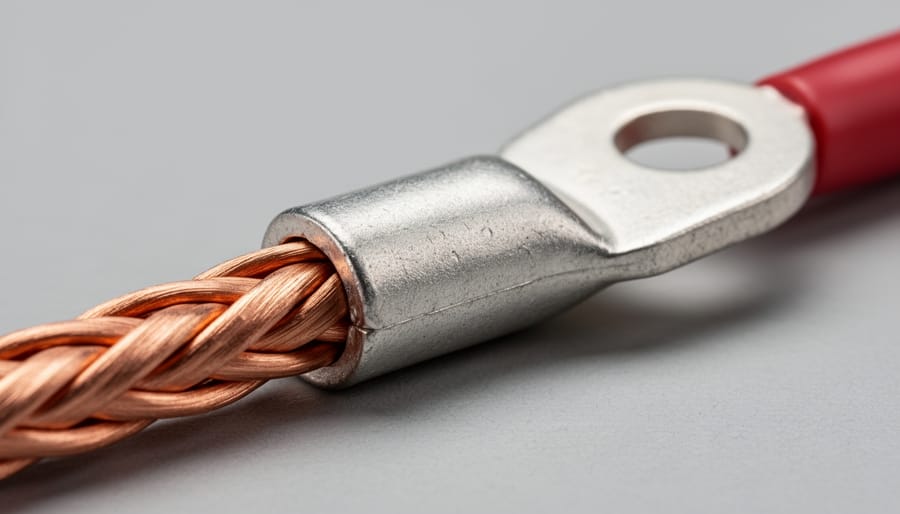
Key Buying Factors for 4 Gauge Crimping Tools
Jaw Capacity and Wire Range
The first specification to check is whether a crimping tool explicitly lists 4 AWG in its wire range. Many tools use vague marketing language like “heavy-duty” or “suitable for large wires” without stating specific gauges. You need a tool that clearly indicates it can handle 4 gauge wire, either in the product specifications or on the tool body itself.
Most crimping tools display their wire capacity using AWG numbers, metric measurements (mm²), or both. For reference, 4 AWG wire has a diameter of approximately 5.19mm or 21.15mm² cross-sectional area. If a tool lists its range as “6 AWG to 2/0” or “10mm² to 70mm²,” you know it covers 4 gauge. Some manufacturers only mark their tools in metric, which can cause confusion for those working in AWG.
Die selection matters significantly for proper crimping. Tools with interchangeable dies offer flexibility to crimp different connector styles, but you must confirm that the specific die set includes 4 gauge sizing. Fixed-jaw tools are simpler but lock you into one crimping profile. Check whether the tool uses labelled die positions or a continuous jaw; labelled positions (often marked with wire sizes) provide more confidence you’re crimping at the correct point. If dies are sold separately, factor their cost into your budget and verify availability before purchasing the tool.
The jaw opening width is another practical consideration. A tool might technically support 4 AWG wire but have insufficient jaw clearance for bulky connectors or insulated terminals. Look for specifications that mention maximum connector dimensions, not just wire size.
Crimping Force and Mechanism Type
Crimping 4 gauge wire demands substantial force, typically 8 to 12 tons of pressure, to properly compress thick copper conductors and create a gas-tight, mechanically secure connection. Insufficient force results in cold crimps that increase resistance, generate heat, and eventually fail. The mechanism type you choose determines how that force is generated and how much physical effort you’ll expend.
Three primary mechanism types handle 4 AWG work, each with distinct advantages:
| Mechanism Type | Force Output | Physical Effort | Portability | Price Range |
|---|---|---|---|---|
| Manual Ratcheting | 8-10 tons | High (multiple pumps) | Excellent | $40-$120 |
| Hydraulic Hand | 10-12 tons | Moderate (hydraulic leverage) | Good | $80-$250 |
| Battery-Powered | 12+ tons | Minimal (electric motor) | Fair (heavier, needs charging) | $300-$800 |
Manual ratcheting crimpers use a compound lever system with a ratchet mechanism. You pump the handles multiple times, often 8 to 15 squeezes for a 4 gauge crimp, as the jaws incrementally close. They work for occasional use but become exhausting when crimping multiple connections.
Hydraulic hand crimpers employ a hand-pump that builds pressure in a small hydraulic cylinder, dramatically reducing the effort needed. A few pumps deliver full force, making them ideal for moderate-volume work or when you’re crimping in awkward positions where leverage is limited.
Battery-powered hydraulic tools eliminate manual effort entirely. An electric motor drives the hydraulic system, completing crimps in seconds with the press of a trigger. These excel in professional settings, marine installers, solar technicians, automotive shops, where you’re crimping dozens of connections regularly. The investment pays off quickly when physical fatigue would otherwise slow your work.
Connector Compatibility
A crimping tool’s effectiveness hinges on its compatibility with the specific connectors you’re using. 4 gauge wire typically connects with copper lugs, battery terminals, ring terminals, or heat-shrink connectors, and each demands proper die sizing and geometry. If your tool can’t accommodate the connector barrel diameter or the correct crimp profile, you’ll end up with weak connections regardless of the force applied.
Fixed-jaw crimpers are designed for specific connector families. They work well if you’re consistently using the same terminal types, but they lock you into a narrow range of applications. For 4 gauge work in automotive or marine settings where you might encounter different battery terminal styles or both standard and heat-shrink lugs, this becomes limiting fast.
Interchangeable die systems offer versatility. You swap dies to match different connector manufacturers, barrel sizes, or crimp styles (hex versus indent). This flexibility matters when you’re working across multiple projects or dealing with varied connector specifications. However, you’ll need to purchase dies separately, and compatibility isn’t universal, dies from one manufacturer rarely fit another’s tool.
Check whether your chosen tool explicitly lists compatibility with the connector brand and style you’ll be crimping. Generic “fits 4 AWG” claims aren’t enough; verify actual connector model numbers whenever possible.
Build Quality and Durability
When you’re applying 8-12 tons of force repeatedly to crimp thick 4 AWG wire, build quality isn’t optional, it’s what keeps the tool functioning and prevents dangerous failures mid-crimp.
Look for frames and handles made from hardened or drop-forged steel rather than cast alloy. Cast construction can develop micro-fractures under high stress, eventually cracking at pivot points or the jaw assembly. Steel frames flex minimally and distribute force evenly, maintaining crimp consistency over thousands of cycles.
Jaw material matters equally. Hardened tool steel dies resist deformation and wear when compressing thick copper lugs. Softer metals or poorly heat-treated jaws will gradually lose their crimp profile, producing weaker connections as the tool ages. Check whether replacement dies are available, even quality jaws eventually wear.
For hydraulic models, inspect cylinder construction and seal quality. Leaking hydraulic fluid signals cheap seals that won’t survive professional use. Reputable manufacturers specify cylinder materials and fluid types, which speaks to their confidence in longevity.
Finally, examine pivot points and ratchet mechanisms. Loose tolerances or thin pins fail under the sustained pressure 4 gauge work demands. A well-built tool feels solid with no play in moving parts, even under load.
Indent vs. Hexagonal Crimping
When crimping 4 gauge wire, you’ll encounter two primary crimping styles: indent (B-crimp) and hexagonal (hex crimp). Understanding the distinction is essential for selecting the right tool and achieving reliable connections.
Indent crimping uses a die that creates a single, wide indentation that compresses the connector barrel onto the wire. This style is common in automotive and marine applications, particularly with copper tube terminals and battery lugs. The broad compression distributes force across a larger contact area, making it well-suited for applications where vibration resistance matters. Most manual ratcheting crimpers for 4 AWG wire use indent-style dies.
Hexagonal crimping creates six compression points around the connector, forming a hexagonal cross-section. This style provides more uniform compression and is often specified for heat-shrink connectors and applications requiring UL or military specifications. Hex crimps typically require hydraulic tools due to the precise, evenly distributed force needed. They’re preferred in solar installations and professional electrical work where code compliance is mandatory.
For occasional automotive or marine battery work, indent crimping with a quality manual tool produces dependable results. If you’re working with heat-shrink connectors or need certified connections, verify that your application specifies hex crimping and choose a hydraulic tool with the appropriate hex dies.
Types of Crimping Tools for 4 Gauge Wire
Manual Ratcheting Crimpers
Manual ratcheting crimpers use a compound leverage system with a ratcheting mechanism that locks incrementally, preventing release until the crimp cycle completes. For 4 gauge wire, you need models rated for at least 8-10 tons of crimping force, standard wire-stripper-style crimpers won’t cut it.
These tools work through sequential squeezes that advance the ratchet pawl, gradually closing the jaws until the crimp finishes. The mechanism ensures you can’t release prematurely and create a partial crimp, which is crucial for thick-gauge connections. Quality models have clearly marked die positions, often labeled with wire gauges and corresponding indent patterns.
Manual ratcheting crimpers excel for occasional automotive or marine projects where you’re making a dozen or fewer crimps. They’re portable, require no power source, and typically cost $40-$80 for adequate 4 gauge capacity. The limitation is physical effort: completing a full crimp on 4 AWG wire requires significant hand strength and multiple squeezes. Your hands will fatigue quickly if you’re doing more than 15-20 crimps.
Die compatibility matters significantly. Better ratcheting crimpers accept interchangeable dies for different connector styles, copper lugs, insulated terminals, battery connectors. Fixed-jaw models lock you into one crimp pattern. Check that the tool’s throat depth accommodates your connector barrel length; some budget models can’t reach fully around larger 4 gauge terminals.
Hydraulic Hand Crimpers
Hydraulic hand crimpers use a manual pump mechanism to generate significantly more force than ratcheting tools, typically delivering 10-16 tons of pressure. This makes them particularly effective for 4 gauge wire, where consistent, complete crimps are non-negotiable for electrical safety.
The hydraulic advantage comes from a two-stage process: you pump a small handle multiple times to build pressure in a cylinder, which then applies uniform force across the entire crimp simultaneously. This eliminates the partial compression risk sometimes seen with ratcheting tools and produces a more reliable connection on thick conductors.
For portability, these tools strike an excellent balance. They don’t require batteries or external power, yet they handle 4 AWG work that would strain purely mechanical crimpers. Most models weigh 5-8 pounds and fit easily in a tool bag, making them ideal for field installations where you can’t drag along bench-mounted equipment.
Hydraulic hand crimpers are the optimal choice when you’re crimping more than occasionally but don’t need the speed of battery-powered tools. They shine in automotive shops, boat yards, and solar installation work where you might crimp a dozen connections per project. The manual pump gives you complete control over the process, and there’s no concern about dead batteries mid-job. Expect to pay $80-200 for quality models with interchangeable dies.
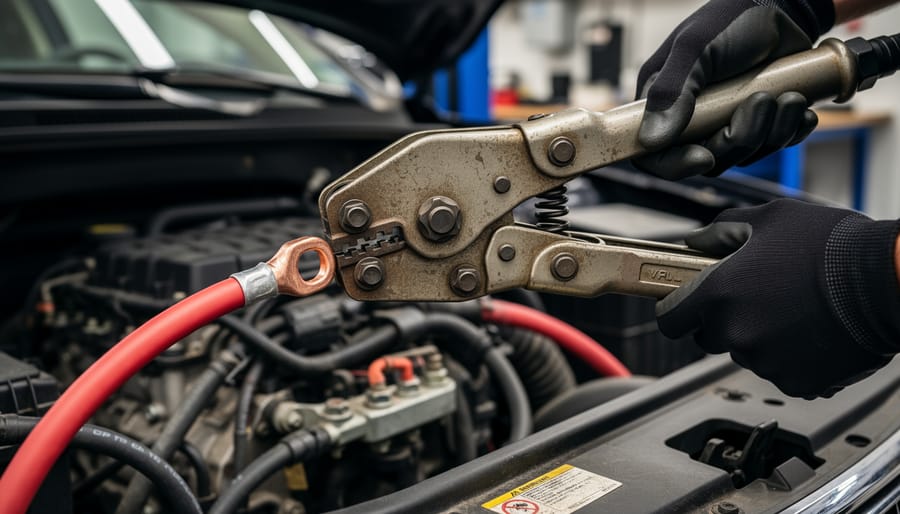
Battery-Powered Hydraulic Crimpers
Battery-powered hydraulic crimpers combine hydraulic force with electric convenience, making them ideal for high-volume 4 gauge work or professional installations. These tools deliver 8-12 tons of crimping force at the press of a trigger, eliminating the physical effort required by manual and hand-pump hydraulic tools.
Most models operate on 18V or 20V lithium-ion battery platforms, with better units completing 300-400 crimps per charge when working with 4 AWG wire. The battery capacity matters significantly for field work where recharging isn’t convenient. Look for tools that accept standard battery systems you may already own, which reduces overall investment.
The primary advantage is speed and consistency. A battery crimper can complete a 4 gauge crimp in 3-5 seconds with uniform pressure every time, compared to 20-30 seconds of pumping with hydraulic hand tools. This efficiency justifies the higher cost for electricians, marine installers, or solar technicians handling dozens of connections per project.
Expect to invest $300-800 for quality battery-powered crimpers suitable for 4 gauge work, with professional-grade models exceeding $1,000. Most include interchangeable dies and cases. The cost becomes reasonable when you’re crimping regularly, but represents poor value for occasional DIY projects where manual tools at $40-150 make more economic sense.
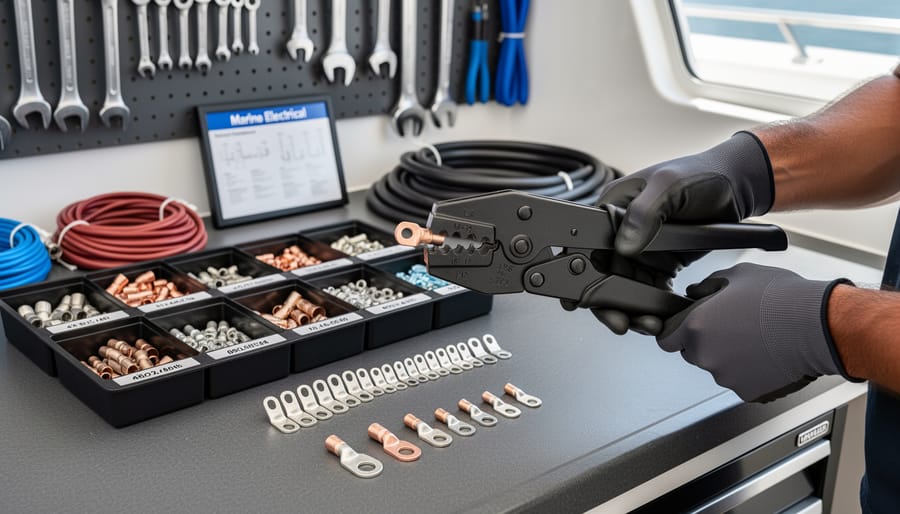
Recommendations: Matching Tool to Your Needs
Selecting the right crimping tool depends less on finding the “best” model and more on matching capabilities to your actual requirements. A weekend DIYer replacing a single battery cable needs a different solution than a marine electrician crimping terminals daily.
For occasional home and automotive use, perhaps making battery cables once or twice a year, or replacing corroded terminals on vehicles or equipment, a quality manual ratcheting crimper with 4 gauge capacity offers the best value. These tools provide adequate force (typically 8-10 tons) for copper lugs and battery terminals without the cost of hydraulic systems. Expect to invest $40-80 for a reliable unit from Klein, TEMCo, or similar brands. The physical effort is manageable for a handful of crimps, and the tool stores easily in a garage toolbox.
If you’re working on a single large project, like wiring a solar array, rigging a boat, or building an RV electrical system, where you’ll make dozens of 4 gauge crimps over several weeks, a hydraulic hand crimper becomes worthwhile. The reduced physical strain matters when you’re making 20-30 crimps in a session. Manual hydraulic tools cost $60-150 but deliver cleaner, more consistent results with less fatigue. They’re particularly valuable for heat-shrink connectors that require precise, centered compression.
Consider these scenarios when matching tool to application:
– For professional marine or automotive electrical work requiring daily 4 gauge crimping, invest in a battery-powered hydraulic crimper ($200-400) to maximize productivity and ensure consistent quality
– For solar installation contractors handling multiple wire gauges from 10 AWG to 4/0, choose a hydraulic tool with interchangeable dies rather than fixed-jaw models
– For emergency roadside service or field repair work, prioritize a manual ratcheting crimper for portability and independence from battery charging
– For industrial or fleet maintenance environments with high volume, battery-powered tools eliminate operator fatigue and reduce crimp time to under 10 seconds per connection
Budget considerations matter, but undersizing the tool costs more in the long run. A $30 crimper that struggles with 4 gauge wire produces unreliable connections, leading to voltage drop, heat buildup, or complete failure in high-current applications. The difference between adequate and inadequate force isn’t visible until the connection fails under load, potentially causing equipment damage or safety hazards.
Your work environment also influences the choice. Fixed workshop settings favor heavier hydraulic tools that don’t need to be portable. Mobile technicians working from trucks need compact, self-contained solutions. Remote locations without electricity access require manual tools.
Common Mistakes to Avoid
Buyers often underestimate the force required for 4 gauge wire and purchase tools rated for lighter work. A standard 4-ton ratcheting crimper designed for 10-14 AWG wire cannot generate the 8-12 tons of pressure needed to fully compress a 4 AWG copper lug. The result is a crimp that looks acceptable on the surface but hasn’t achieved proper metal-to-metal contact throughout the barrel. These weak connections create high resistance, generate heat under load, and can fail catastrophically in high-current applications like starter cables or solar arrays.
Another frequent mistake is ignoring connector compatibility and attempting to use automotive-style indent crimpers on hexagonal lugs, or vice versa. Each crimping style creates a different compression pattern, and using the wrong type produces an unreliable connection regardless of applied force. Some buyers also overlook the physical jaw opening, purchasing a tool that technically handles 4 AWG wire but has a throat depth too shallow to accommodate larger barrel diameters on ring terminals or battery lugs.
Budget-focused shoppers sometimes select tools without interchangeable dies, then discover their fixed jaws only work with one connector style. For anyone working with various 4 gauge applications, the cost savings of a single-purpose tool quickly disappear when a second tool becomes necessary. Finally, many neglect to verify the actual wire capacity marking on the tool itself, relying instead on vague product descriptions that list broad ranges without confirming 4 AWG is explicitly supported at the rated crimping force.
Frequently Asked Questions
Can you use a manual ratcheting tool for 4 gauge wire, or do you need hydraulic?
Manual ratcheting tools work for occasional 4 gauge crimps if they’re rated for at least 8-10 tons of force and specifically list 4 AWG in their range. For regular use or professional applications, hydraulic hand crimpers deliver more consistent results with less physical effort.
Do you need to strip 4 gauge wire before crimping?
Yes, you must strip back the insulation to expose the bare conductor strands before crimping. Most 4 gauge lugs and terminals require 1/4 to 3/8 inch of exposed wire, though always check your specific connector’s requirements for the exact strip length.
How do you know if you’ve achieved a good crimp on 4 gauge wire?
A proper crimp should compress the connector evenly around the wire with no visible gaps, and the wire should not pull out when tugged firmly. The connector barrel should show a clean, uniform indent pattern, and you should see slight conductor bulge at the open end of the barrel without any strands cut or damaged.
Can you crimp 4 gauge wire with interchangeable dies, or do you need a dedicated tool?
Tools with interchangeable dies work well for 4 gauge wire and offer more versatility if you work with multiple wire sizes or connector types. Just ensure the die set includes the specific profile your connectors require, whether that’s hexagonal for compression lugs or indent style for standard battery terminals.
The physical demands of crimping thick-gauge wire mean tool maintenance matters more than with smaller sizes. Clean the crimping jaws and dies after dusty work environments, apply a light lubricant to pivot points and hydraulic mechanisms, and inspect dies for wear or damage before each major project. Tools working at their force limits will show stress faster than those with excess capacity, so a slightly oversized tool often proves more durable for regular 4 gauge work.
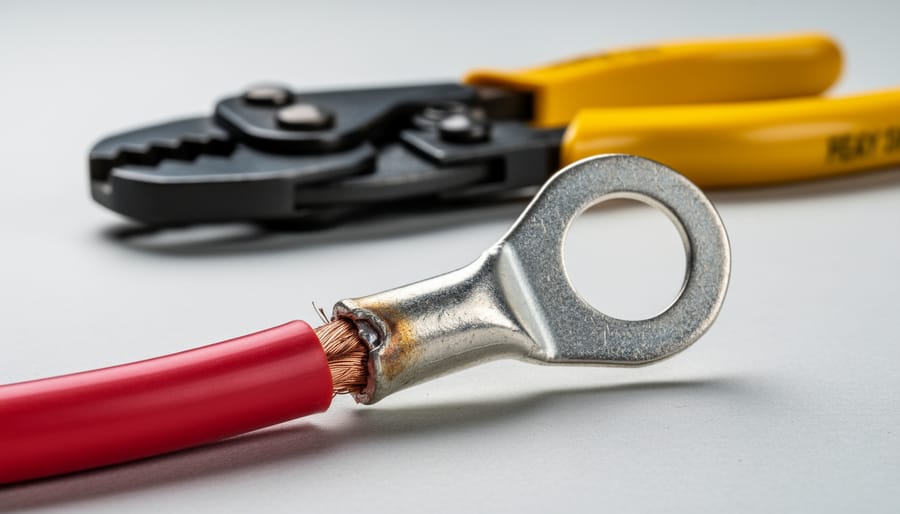
Selecting the right crimping tool for 4 gauge wire isn’t just about convenience, it’s about ensuring safe, reliable connections in high-current applications where failure isn’t an option. The key takeaway is straightforward: prioritize force capacity and connector compatibility over price. A tool that can’t deliver adequate crimping force or doesn’t match your connector types will create weak, potentially dangerous connections, regardless of how affordable it seems.
Your decision should center on three critical factors. First, verify the tool genuinely handles 4 AWG wire with sufficient force (typically 8-12 tons). Second, confirm it accommodates your specific connector types, whether copper lugs, battery terminals, or heat-shrink connectors. Third, match the mechanism type, manual ratcheting, hydraulic hand, or battery-powered, to your usage frequency and work environment.
Remember that automotive, marine, and solar installations demand connections that withstand vibration, temperature extremes, and continuous high current. A properly crimped 4 gauge connection often outlasts the wire itself. Cutting corners on tool selection compromises this durability and creates safety risks. Invest in a tool that meets the actual demands of thick-gauge work, and you’ll have reliable connections for years to come.