
Choosing the right electrical wire stripping tool comes down to matching the tool category to your wire gauge range, workload frequency, and required precision level. Manual strippers offer maximum control for occasional residential work, self-adjusting models eliminate gauge guesswork for frequent DIY tasks, and electric strippers become cost-effective when you’re processing hundreds of wires daily. The Klein Tools 11061 8-Inch Self-Adjusting Wire Stripper/Cutter and haisstronica 3 in 1 Self-Adjusting Wire Stripper both handle 10-24 AWG with one-squeeze operation, making them practical starting points for most home network installations and basic electrical projects.
The wire stripping landscape has consolidated around four distinct categories, each engineered for different use cases. Manual notched strippers require you to select the correct gauge slot but deliver clean cuts on jacketed cable when precision matters. Self-adjusting tools automatically grip the wire diameter and strip insulation without pre-selection, cutting setup time on mixed-gauge projects. Multifunction models combine stripping with crimping and cutting in a single tool, reducing your carry weight for field work. Electric strippers justify their footprint when repetitive production stripping causes hand fatigue or when contract deadlines demand throughput that manual methods can’t sustain.
Your wire gauge range drives compatibility more than any other spec. Residential Romex typically runs 14-10 AWG for lighting and outlet circuits, while low-voltage networking and speaker wire often sits in the 18-24 AWG range. The IDEAL Electrical 45-247 Premium T-14 NM T-Stripper targets sheathed cable specifically, while the Klein Tools 12075 Heavy-Duty Wire Strippers handle solid and stranded conductors across a broader gauge spectrum. Matching your tool’s rated capacity to your actual wire inventory prevents insulation nicks that compromise conductor integrity and trigger future troubleshooting headaches.
Key Factors for Wire Stripping Tool Selection
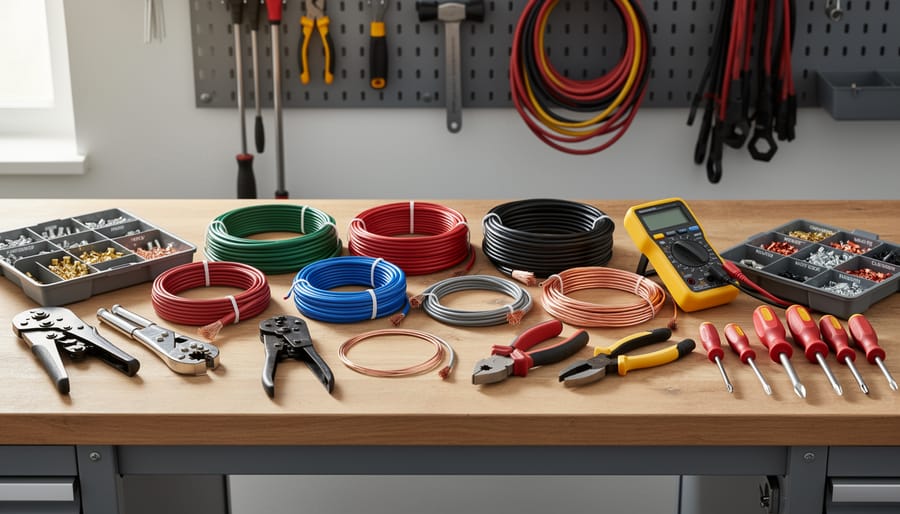
Choosing the right wire stripping tool depends on matching its capabilities to your specific wiring projects. The most critical factor is wire gauge compatibility, confirm the tool handles the American Wire Gauge (AWG) range you work with most often. Residential electrical work typically involves 10-14 AWG for outlets and lighting circuits, while electronics and low-voltage applications often use 18-24 AWG. A stripper rated for 10-24 AWG covers both ranges, but professionals working with larger commercial cables need tools that accommodate 4 AWG or even 4/0 AWG conductors.
Manual versus automatic operation represents a fundamental choice that affects speed and precision. Manual strippers with fixed notches require you to select the correct gauge slot and apply controlled pressure, giving experienced users precise control over stripping depth and minimizing nicks in the copper conductor. Self-adjusting models automatically detect wire diameter and adjust cutting depth, making them faster for mixed-gauge work and more forgiving for occasional users. If you strip dozens of wires daily with varying gauges, automatic operation saves significant time. For precision work where a single damaged conductor means redoing a connection, manual control may serve you better.
Build quality directly impacts tool lifespan and stripping consistency. Look for cutting blades made from hardened steel or alloy steel, these materials maintain sharp edges through thousands of strips and resist deformation under pressure. Forged construction outlasts cast or stamped tools, particularly for professional applications. Check whether the manufacturer offers replacement blades; models with replaceable cutting components extend tool life significantly and reduce long-term costs.
Multifunction capabilities add versatility but introduce trade-offs. Combination tools that integrate wire cutting, crimping terminals, and stripping functions into one handle reduce the number of tools you carry, which matters for field work or tight spaces. However, dedicated single-purpose tools typically outperform multifunction designs in their primary task. A stripper with an integrated wire cutter may excel at stripping but offer only basic cutting performance compared to purpose-built diagonal cutters.
Handle ergonomics matter during extended use. Spring-loaded handles that automatically reopen reduce hand fatigue when stripping dozens of wires in succession. Cushioned grips improve comfort, and overall tool length affects leverage, 8-inch handles suit most tasks, while longer handles provide more cutting force for heavier gauge wire.
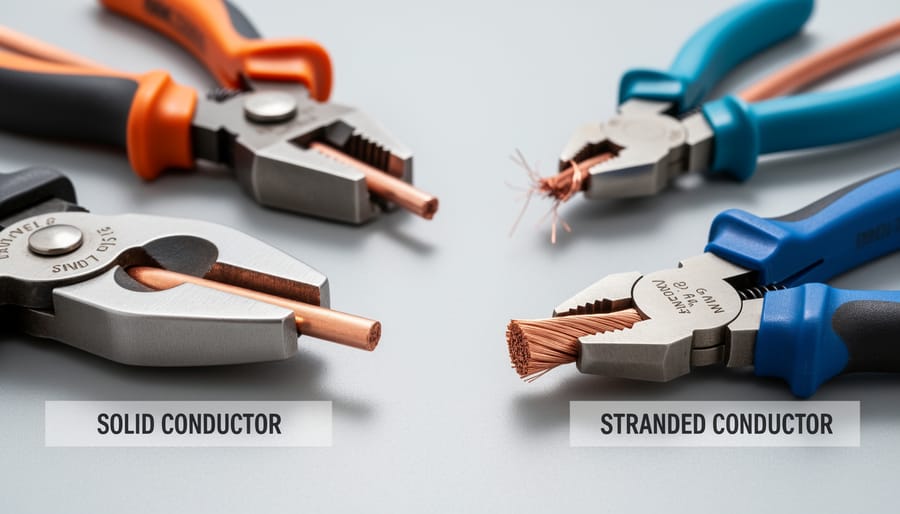
Types of Wire Stripping Tools Compared
Manual Wire Strippers
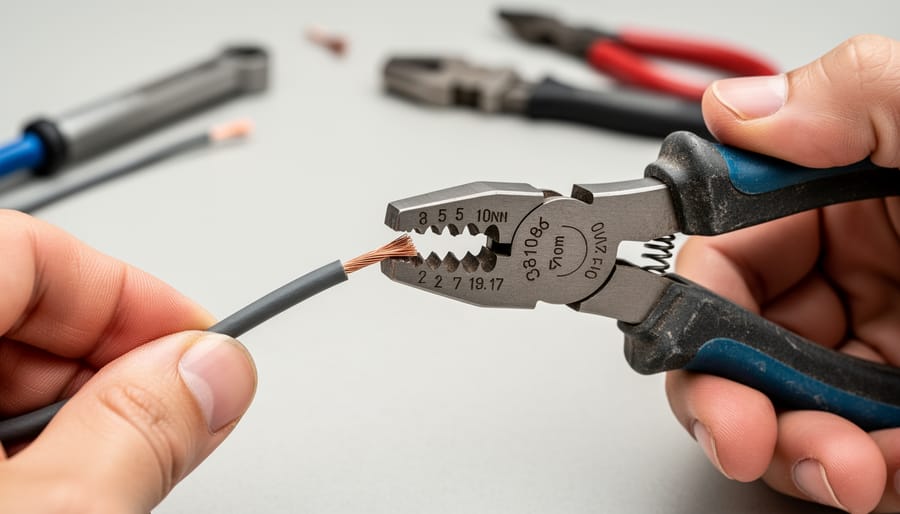
Manual wire strippers represent the traditional approach to wire preparation, featuring a series of fixed notches calibrated to specific wire gauges. Each notch corresponds to a particular AWG size, typically ranging from 10 AWG to 22 AWG on most models. You position the wire in the appropriate notch, squeeze the handles, and pull to remove the insulation cleanly.
The precision advantage of manual strippers comes from their direct control. Because you’re selecting the exact gauge notch for your wire, you eliminate the risk of cutting too deep into the conductor, a problem that weakens wire and creates electrical hazards. This makes manual strippers ideal for working with solid-core conductors where accuracy matters most, and for situations where you’re stripping the same gauge repeatedly throughout a project.
Professional electricians favor manual strippers for commercial installations where they’re working with uniform wire sizes all day. The tool’s simplicity means fewer moving parts to fail, and the fixed notches maintain consistent performance across thousands of strips. They’re also the most affordable option, making them practical for occasional DIY use when you know exactly which wire gauges you’ll be handling.
Self-Adjusting Wire Strippers
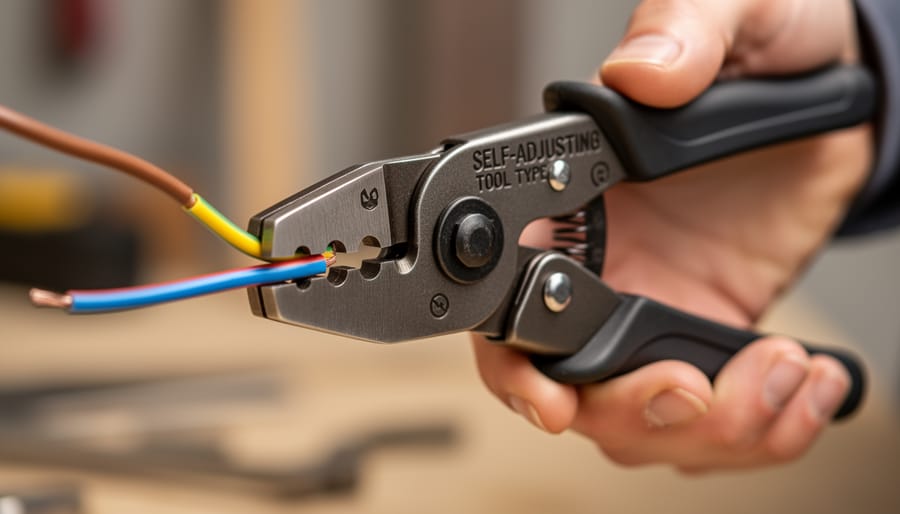
Self-adjusting wire strippers detect wire gauge automatically and clamp the correct amount of pressure without requiring you to select a specific notch. You insert the wire, squeeze the handles, and pull, the tool recognizes whether you’re stripping 10 AWG or 24 AWG and adjusts accordingly. This eliminates the trial-and-error of finding the right slot and speeds up repetitive stripping tasks considerably.
Most self-adjusting models cover a range from 10 AWG to 24 AWG, handling both solid and stranded conductors. The mechanism uses spring-loaded jaws that grip the insulation firmly enough to remove it cleanly but not so hard that they nick the copper underneath. For electricians moving quickly through junction boxes or hobbyists who don’t want to memorize gauge sizes, this automatic operation cuts down on errors and damaged wire ends.
The trade-off is slightly less tactile feedback compared to manual strippers. You rely on the tool’s internal calibration rather than your own judgment of pressure. However, quality self-adjusting strippers deliver consistent, clean cuts across their entire AWG range, making them a practical choice when you’re working with mixed wire sizes or need faster throughput than manual models allow.
Multifunction Tools
Multifunction tools consolidate wire stripping, cutting, and crimping into a single device, which makes them particularly valuable when you’re working in confined spaces or need to travel light between job sites. Instead of carrying three separate tools, you get one that handles the most common wire preparation tasks. The trade-off is that each function might not perform quite as well as a dedicated tool, but for general electrical work and field repairs, the convenience often outweighs this limitation.
Most multifunction strippers handle 10-24 AWG wire, though some extend the range slightly in either direction. They typically include insulated or non-insulated terminal crimping, wire cutting blades, and self-adjusting stripping jaws that grip the insulation without damaging the conductor. If you regularly work with larger conductors, you’ll need a specialized crimping tool for 4 gauge wire rather than relying on a general-purpose multifunction stripper.
Build quality varies significantly. Budget models around ten dollars work for occasional use, but their jaws can misalign after moderate wear, leading to inconsistent strips and nicked conductors. Professional-grade multifunction tools use hardened steel components and precision-machined adjustment mechanisms that maintain accuracy through thousands of cycles, making them worth the investment if you strip wire daily.
Electric Wire Stripping Machines
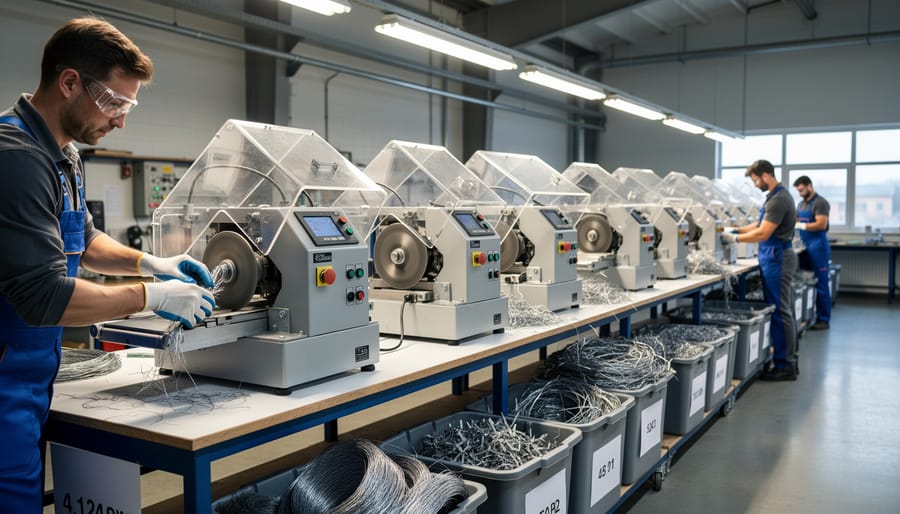
Electric wire stripping machines represent a specialized category designed for high-volume applications where manual stripping becomes impractical. These powered units automate the entire stripping process, feeding wire through at set lengths and automatically removing insulation without damaging the conductor beneath.
Professional electricians, industrial settings, and electronics manufacturers rely on electric strippers when processing hundreds or thousands of wires daily. The machines typically handle a wider diameter range than manual tools, with some models accommodating everything from delicate electronics wire to heavy-gauge industrial cable. They eliminate hand fatigue entirely and deliver consistent, repeatable results across large production runs.
Most electric strippers feature adjustable depth settings to prevent nicking the copper core, variable speed controls for different wire types, and preset length functions that speed up batch processing. The trade-off comes in portability and cost, these machines require power sources, occupy dedicated workspace, and command significantly higher prices than handheld alternatives.
For residential work or occasional projects, electric strippers offer little advantage over quality manual tools. They shine in commercial environments where stripping speed directly impacts productivity, such as panel assembly shops, automotive wiring harness production, or electrical contractor operations handling new construction at scale. Before investing in an electric unit, calculate your actual daily stripping volume to determine whether the efficiency gains justify the equipment cost.
IDEAL Electrical 45-247 Premium T-14 NM T-Stripper

The IDEAL Electrical 45-247 T-Stripper targets electricians and DIYers working primarily with residential NM cable. Built for 12 and 14 AWG wire, it specializes in the most common household wiring gauges rather than offering a broad AWG range. This focused design makes it particularly efficient for running circuits, installing outlets, and handling standard romex work where you strip the same wire sizes repeatedly.
Spring-loaded automatic opening sets this tool apart from basic manual strippers. After each strip, the jaws return to the open position without finger pressure, reducing hand fatigue during repetitive tasks like wiring a panel or running dozens of outlets. The mechanism maintains consistent tension across the lifespan of the tool, so you don’t fight weakening springs after a few months of use.
Integrated looping holes let you form wire hooks for screw terminals without switching to needle-nose pliers. These holes accommodate both 12 and 14 AWG conductors and create uniform loops sized correctly for standard terminal screws. The plier nose extends the tool’s utility beyond stripping, handling wire positioning, connector tightening, and small component work that would otherwise require carrying an additional tool on your belt.
The T-Stripper earns a 4.4 out of 5 rating from 99 customer reviews and remains in stock. Its specialty design means it excels at residential wiring but won’t suit projects involving 10 AWG circuits, low-voltage 18-22 AWG work, or the wire gauge variety that demands a self-adjusting model. If your projects center on standard home electrical installation and you value speed over versatility, this tool streamlines the specific task it was designed to handle.
Klein Tools 12075 Heavy-Duty Wire Strippers

The Klein Tools 12075 stands apart as a premium choice for electricians who demand durability and reliability in their daily work. This heavy-duty wire stripper earns its professional reputation through forged steel construction that withstands years of demanding job-site use without bending or losing precision.
What makes this model particularly efficient is its self-opening mechanism. After each cut, the jaws spring back automatically, eliminating the repetitive hand motion that causes fatigue during all-day stripping tasks. You can work through a panel’s worth of connections without the constant squeeze-and-release cycle that slows down manual strippers.
The integrated shear cutter adds genuine versatility. Instead of switching between separate tools to cut wire and strip insulation, you handle both operations with one implement. The shear delivers clean cuts through solid and stranded wire without fraying or crushing the conductor, which matters when you’re making terminations that need to pass inspection.
Klein designed the straight handle geometry to maximize leverage and control. The aligned grip puts your hand strength directly behind the cutting action rather than forcing you to work at an angle. This design choice reduces hand strain and gives you better feel for the stripping depth, which helps prevent nicking the copper underneath the insulation.
The exceptional 5.0 rating from 34 reviews reflects consistent real-world performance. Professional users specifically praise the tool’s longevity and the precision of its stripping action across different wire gauges. With in-stock availability, contractors can replace worn tools without waiting through backorders that delay project timelines.
This stripper fits electricians running heavy schedules who need a tool that performs reliably shift after shift without the quality degradation that cheaper alternatives show after a few months of hard use.
AMZCNC Cable Stripper Tool 12

The AMZCNC Cable Stripper Tool 12 targets electricians and technicians working with heavier gauge wire, handling cables from 12 AWG down to 4/0 AWG, a range that covers everything from residential branch circuits to substantial feeder cables. This reach makes it useful for professionals who regularly strip larger conductors where standard household wire strippers fall short.
The standout feature is the preset depth mechanism. Instead of guessing how far to squeeze or risking nicks in the copper strands, this tool stops at a calibrated depth for each wire size, which protects the conductor integrity and maintains full current-carrying capacity. When you’re working with expensive large-gauge cable, avoiding even minor copper damage pays for the tool quickly.
Users give it a 4.5 out of 5 rating from 70 customer reviews, and the tool is currently in stock. The heavy-duty construction reflects its intended professional use, this isn’t a light-duty household stripper, but rather a jobsite tool built to handle repetitive stripping of substantial cables without fatigue or slop in the mechanism.
The fast, clean cutting action comes from the combination of sharp blades and the controlled depth stop. You get consistent strip length and minimal cleanup, which matters when you’re running dozens of terminations in a panel or junction box. The tool eliminates the back-and-forth scoring and twisting that manual methods require on thick insulation.
If your work involves routine stripping of 10 AWG or larger conductors, service upgrades, subpanel installations, industrial control wiring, this stripper addresses the specific challenges of that wire range better than adapting a smaller tool or resorting to a knife.
VEVOR Electric Wire Stripping Machine 0.06″-0.98″ Automatic Wire

The VEVOR electric wire stripping machine targets high-volume applications where manual stripping becomes tedious and time-consuming. With a diameter range spanning 0.06″ to 0.98″, this automated tool handles everything from thin gauge control wiring to heavy-duty power cables in a single machine, eliminating the need to swap tools or manually adjust for different wire sizes.
The electric motor drives a blade mechanism that automatically cuts and removes insulation once you feed the wire and press the foot pedal or switch. This hands-free operation dramatically increases stripping speed compared to manual tools, particularly valuable in commercial electrical installations, electronics manufacturing, and cable assembly operations where workers process hundreds or thousands of wires per shift. The consistent depth control prevents the blade from nicking the conductor, a common problem when hand-stripping large wire quantities leads to fatigue and attention lapses.
Setup requires adjusting the blade depth and feed length for your specific wire type, but once calibrated, the machine maintains that setting across batches. The wide diameter tolerance means you can strip 18 AWG thermostat wire and 4/0 welding cable with the same unit, though you will need to recalibrate between vastly different sizes. The bench-mounted design keeps the tool stable during operation, and the electric drive delivers uniform stripping force that manual grip strength cannot match over extended periods.
With a 4.7 out of 5 rating from 704 customer ratings and current in-stock availability, the VEVOR electric stripper earns its place in professional environments where stripping speed and consistency directly impact productivity. For occasional residential work or low-volume projects, the upfront cost and setup time make manual or self-adjusting strippers more practical, but commercial operations processing bulk cable will recoup the investment quickly through labor savings.
Manual Wire Stripper Replacement Blades *2

Replacement blades extend the service life of quality wire strippers rather than forcing you to buy a complete new tool when cutting edges wear down. These Manual Wire Stripper Replacement Blades come as a two-piece set made from hardened steel, offering the edge durability needed to handle hundreds of stripping cycles without dulling. When you notice your current blades crushing wire insulation instead of cleanly cutting through it, or leaving burrs on the copper conductor, it’s time to swap in fresh blades rather than struggle with a degraded tool.
Blade compatibility matters more than most users realize. Not all replacement blades fit every stripper model, so you need to match tool specs before ordering. Check your wire stripper’s manufacturer specifications or model number to confirm these blades will mount correctly and align properly with the tool’s stripping mechanism. Ill-fitting blades create uneven gaps that damage conductors or fail to strip insulation cleanly.
The long-term cost savings add up quickly. A $20 blade set that restores a $60 professional stripper to like-new condition makes better financial sense than replacing the entire tool every year or two. With a 4.4 out of 5 rating from 81 customer reviews and in-stock availability, these replacement blades represent a practical maintenance solution for anyone who strips wire regularly. Keep the original packaging or your tool’s model information handy when shopping for replacement blades to avoid compatibility headaches.
haisstronica 3 in 1 Self-Adjusting Wire Stripper

The haisstronica 3 in 1 Self-Adjusting Wire Stripper targets users who want multifunction capability across a practical wire gauge range without carrying multiple tools. This model handles AWG 24-10, covering most residential and light commercial applications from thermostat wiring to branch circuits. If you are learning what is C wire for HVAC installations, this stripper accommodates the 18-20 AWG conductors commonly used in those systems.
The alloy steel blades provide durability for repeated stripping without excessive edge wear, a concern with cheaper plastic-bodied tools that dull quickly. The adjustable strip length feature lets you preset how much insulation to remove, maintaining consistency across multiple connections and reducing the risk of cutting into the conductor when you are working on a batch of wires. This adjustment matters most when you are terminating wires that need specific exposure lengths for push-in connectors or wire nuts.
Compatibility with both solid and stranded conductors expands the tool’s usefulness beyond single-wire-type projects. Solid wire, typical in permanent installations, requires different blade pressure than stranded wire, which compresses under the same force. The self-adjusting mechanism accounts for this difference, gripping each wire type appropriately without requiring manual gauge selection between cuts.
The ergonomic grip design reduces hand fatigue during extended stripping sessions, though grip comfort remains subjective and hand-size dependent. A 4.6 out of 5 rating from 4,012 customer ratings suggests broad user satisfaction, and the tool is currently in stock. The combination of wire-type flexibility, gauge range, and adjustable strip length makes this stripper a practical choice for electricians and serious DIYers who tackle varied wiring projects rather than repetitive single-gauge work.
DOWELL Wire Stripper

The DOWELL 10-22 AWG wire cutter and stripping tool occupies the budget-friendly end of the market while delivering surprisingly capable dual functionality. With a 4.6 out of 5 rating from 11,199 customer reviews and in-stock availability, it has earned widespread user confidence through consistent performance in residential and light commercial applications.
This tool handles wire gauges from 10 through 22 AWG, covering the range most DIY enthusiasts and residential electricians encounter daily in outlet wiring, lighting circuits, and low-voltage installations. The integrated cutter eliminates the need to switch between separate tools mid-task, streamlining workflow when you’re working inside junction boxes or panel enclosures where space is tight.
The dual-purpose design means you can cut cable to length and strip insulation without setting the tool down. This matters most during repetitive tasks like wiring multiple receptacles or preparing a dozen conductors for termination. The time savings accumulate quickly across a full project.
Build quality at this price point naturally involves trade-offs. The tool delivers reliable stripping action for household wiring but may show wear faster than forged professional-grade models under heavy daily use. For weekend projects, home renovations, or occasional electrical work, it provides excellent value. Full-time electricians running hundreds of strips weekly might prefer a more robust option, but for intermittent use the durability proves adequate.
The tool’s straightforward operation requires no adjustment or calibration, making it accessible for first-time users who want to avoid bad crimping and stripping mistakes that damage conductors. The substantial review base confirms its reliability across diverse applications, from automotive wiring to smart home installations.
Klein Tools 11061 8-Inch Self-Adjusting Wire Stripper/Cutter

The Klein Tools 11061 brings professional-grade performance to an 8-inch self-adjusting design that automatically detects wire gauge and strips cleanly without manual adjustment. This model handles 10-22 AWG solid and 12-24 AWG stranded wire, making it suitable for both residential wiring projects and network cable work where you need to choose quality Ethernet cables and prepare their conductors properly.
The automatic stripping mechanism eliminates the need to rotate a dial or select the correct notch, a time-saver when working with mixed wire sizes in a single project. The integrated cutter handles copper wire cleanly, and the forged construction provides the rigidity needed for consistent results across thousands of strips. Unlike lighter self-adjusting tools that can nick stranded conductors or slip on solid wire, the Klein 11061’s spring-loaded jaws grip firmly enough to prevent movement during the strip cycle.
The 8-inch length offers more leverage than compact 6-inch models, reducing hand fatigue during extended use. This matters when you’re stripping dozens of connections for tasks like terminating patch panels, installing outlets, or running low-voltage cable where understanding CAT8 cable specs helps you select appropriate conductors. The tool’s dual functionality replaces carrying separate strippers and cutters, streamlining your work kit much like knowing how to pick a reliable splitter eliminates repeat purchases.
With a 4.6 rating from 10,582 customer reviews and in-stock availability, this Klein model demonstrates the reliability professional electricians expect from a tool they’ll use daily. The self-adjusting feature trades precision control for speed, making it best suited for standard building wire rather than delicate electronics work where a fixed-notch stripper offers finer control.
Common Mistakes to Avoid When Choosing Wire Stripping Tools
Choosing the wrong wire stripping tool wastes money and leads to frustration on every project. The most common mistake is buying a stripper without checking its wire gauge compatibility, then discovering it won’t handle your most frequent wire sizes. A tool rated for 10-24 AWG works well for residential lighting circuits but fails completely when you need to strip heavier 8 AWG or 6 AWG conductors for appliance circuits or subpanel feeds. Always verify the AWG range matches the wire gauges you actually work with, not just the most common sizes.
Another frequent error is choosing the cheapest available option without considering build quality or durability. Tools with thin steel blades, weak springs, or plastic adjustment mechanisms fail quickly under regular use, requiring replacement within months and costing more over time than a quality tool purchased initially. Look for hardened steel cutting surfaces, robust spring mechanisms, and metal adjustment components rather than prioritizing lowest price alone.
Many buyers select self-adjusting strippers for convenience without recognizing their limitations for precision work. Self-adjusting models work well for general tasks and varied wire sizes, but they lack the exact depth control needed for delicate wiring or when stripping only a short segment of insulation. If your projects demand precise strip lengths or involve fragile conductors, a manual stripper with fixed notches gives better results despite requiring gauge selection for each wire.
Overbuying multifunction tools creates another common problem. A wire stripper that also cuts, crimps, and performs five other functions sounds appealing, but each additional feature reduces the tool’s effectiveness at its primary stripping task. Unless you genuinely need connector crimping basics and wire cutting in a single tool for portability reasons, separate dedicated tools typically deliver superior results for each function.
Finally, ignoring ergonomics and handle design leads to hand fatigue and reduced accuracy during extended use. Tools with short handles require excessive grip force, while models lacking cushioned grips cause discomfort after 15-20 minutes of continuous stripping. For professional use or large projects, prioritize comfortable grip design and adequate handle length over compact size.
Recommendations by Use Case
For homeowners tackling occasional DIY electrical projects, the haisstronica 3 in 1 Self-Adjusting Wire Stripper delivers excellent value with its AWG 24-10 range covering standard household wiring. Its self-adjusting mechanism eliminates gauge guesswork during infrequent use, and the multifunction design handles cutting and crimping without requiring separate tools. Budget-conscious buyers working with lighter wire gauges should consider the DOWELL Wire Stripper, which covers 10-22 AWG at a fraction of professional tool prices while maintaining solid performance for home automation and electronics work.
Professional electricians running daily service calls benefit most from the Klein Tools 11061 8-Inch Self-Adjusting model, which combines automatic gauge detection with the durability Klein’s professional line is known for. For specialized residential NM cable work, the IDEAL Electrical 45-247 Premium T-Stripper’s spring-loaded design and looping holes speed up switch and outlet installations significantly.
High-volume commercial operations and industrial settings justify the investment in the VEVOR Electric Wire Stripping Machine, which processes 0.06″ to 0.98″ diameter cables automatically and eliminates repetitive strain injuries during production runs. Contractors working exclusively with heavy gauge service entrance cables gain precision from the AMZCNC Cable Stripper Tool 12, which prevents copper damage on 12-4/0 AWG conductors through its preset depth control.
Frequently Asked Questions
What wire gauge range do I need for my projects?
Most residential electrical work involves 10-14 AWG wire, so a stripper covering 10-24 AWG handles household wiring, automotive work, and electronics projects. Professionals working with heavier cables need tools that extend to 4 AWG or larger, while fine electronics work requires precision down to 24 or even 26 AWG.
Are self-adjusting wire strippers better than manual models?
Self-adjusting strippers offer faster operation and eliminate gauge selection, making them ideal for varied wire sizes and repetitive tasks. Manual strippers with fixed notches provide more control and precision for specific gauge work, particularly when stripping damaged or non-standard wire where automatic mechanisms might slip.
Can one wire stripper handle both solid and stranded wire?
Quality strippers designed for both conductor types adjust their grip pressure to prevent cutting stranded wire while still cleanly removing insulation from solid wire. Check the product specifications, many self-adjusting models explicitly state compatibility with both, while some manual strippers work best with one type.
How do I maintain wire stripper blades for consistent performance?
Wipe blades clean after use to remove copper shavings and insulation residue, occasionally apply a drop of light machine oil to pivot points, and inspect cutting edges for nicks or dullness. When blades lose their clean-cutting edge despite cleaning, replace them rather than continuing with a tool that damages wire, replacement blade sets cost far less than the wire you’ll ruin.
Beyond these core questions, consider your work environment when selecting a stripper. Tools used outdoors or in dusty conditions benefit from sealed pivot mechanisms that resist contamination, while shop-based stripping calls for comfortable grips that reduce hand fatigue during extended sessions. The difference between a $10 stripper and a $40 professional model often comes down to blade material quality and how many strips the tool delivers before performance degrades, hardened steel blades in premium tools maintain their edge through thousands of strips, while softer metals dull quickly and require frequent replacement.
Pay attention to the specific insulation types you strip most often. PVC-insulated wire strips cleanly with most tools, but tougher materials like cross-linked polyethylene or fluoropolymer coatings demand sharper blades and more aggressive cutting geometry. If you regularly work with specialized cable types, verify that your chosen stripper explicitly supports those insulation materials rather than assuming universal compatibility.
Selecting the right wire stripping tool comes down to three core considerations: matching the gauge range to your actual wiring work, choosing a tool type that fits how you’ll use it, and investing in quality construction that won’t fail mid-project. A budget self-adjusting stripper handles occasional home repairs perfectly well, while frequent electrical work demands the precision and durability of a professional-grade manual or electric model.
The tools covered here span that full spectrum because different projects have different demands. If you’re running 12/14 AWG Romex through walls weekly, you need something built for that specific task. Weekend DIYers stripping lamp cords benefit more from versatility than specialization. Don’t overthink it, buy for the wire you actually strip, not every gauge you might someday encounter.
The right stripper does more than remove insulation cleanly. It protects the copper conductor from nicks that create resistance hotspots, saves the time you’d waste re-stripping damaged wire, and reduces hand fatigue when you’re processing dozens of connections. Match the tool to the project, prioritize the features that matter for your work, and you’ll avoid both the frustration of inadequate tools and the waste of overbuying capabilities you don’t need.
I use affiliate links on some of the products I cover, if you buy through them, I earn a small commission. As an Amazon Associate I earn from qualifying purchases.