
For 8 AWG stranded wire, the right tool is a heavy-duty stripper with a dedicated cutting notch or an adjustable blade, not a general-purpose hand stripper built for thin copper. The wire’s roughly 3.3 mm conductor and thick insulation are where cheap tools fail, either by nicking strands or by crushing the jacket without cutting it cleanly.
In the interest of transparency, we earn a commission on some purchases made through links on this site. As an Amazon Associate I earn from qualifying purchases.
Stranded copper is the real challenge. Each of those strands is thin, and one careless squeeze can slice several of them, which lowers the wire’s current capacity at the exact point where a lug or connector grips it. A good wire stripping tool cuts the insulation through and leaves the conductor intact.
Your options fall into a few families: fixed-notch heavy-duty strippers such as the Klein Tools 12075 Heavy-Duty Wire Strippers self-adjusting designs like the Klein Tools 11061 8-Inch Self-Adjusting Wire Stripper/Cutter multi-function pliers, and powered machines for high-volume work. Each suits a different job, and the guide below breaks down the factors that matter, compares the tool types, and reviews all eight products so you can match one to your wire, your volume, and your hands.
What Makes 8 AWG Stranded Wire Tricky to Strip
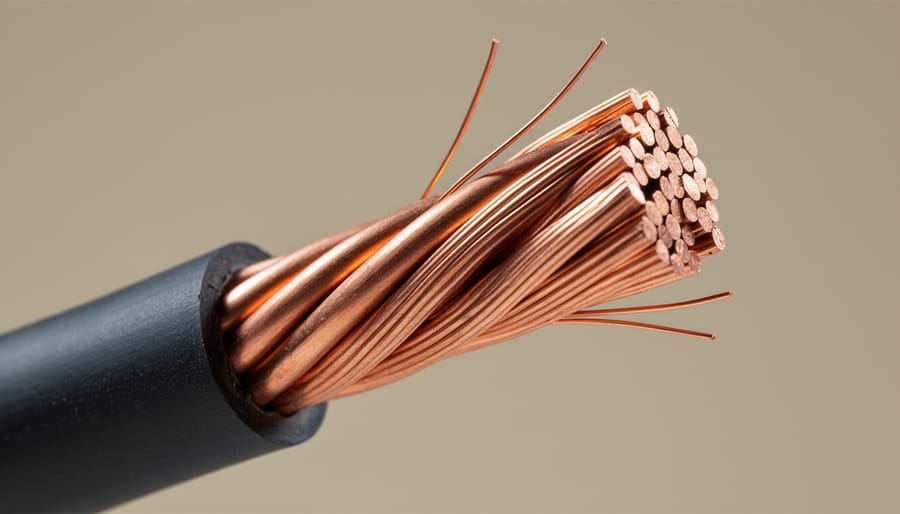
8 AWG stranded wire is a different animal from the thin hookup wire most strippers are built around. The copper conductor is roughly 3.3 mm across, wrapped in thick insulation, and it’s made of many fine strands twisted together rather than one solid core. That combination is what makes it easy to mess up.
When the jaw is too small, it bites into the copper and shears strands. When it’s too large, it slips and drags the insulation instead of cutting it cleanly. Set the depth a hair too deep and you nick the outer strands, which you can’t see until the wire is under load. Cut too shallow and the insulation slug hangs on, so you pull and splay the strands into a frayed mess. Damaged strands mean less copper carrying current, and that shows up as extra heat at the termination.
You’ll run into this gauge more often than you might think:
– Solar and battery runs, where the setup is similar to what’s covered in what is C wire and connector crimping
– Car audio amplifiers and other 12V power feeds
– Subpanel and appliance feeds
– Welding and workshop circuits
Even in a basic power-conversion setup, the “0 power rule” idea reminds you that a bad termination wastes real power as heat. That’s why a clean strip matters as much as a solid crimp or lug.
Spec ranges on the market vary a lot. One multi-tool stripper/crimper lists 6-12 AWG stranded, while another tool is listed for 16 AWG to 3 AWG. Both technically include 8, but only one has real margin around it, which is worth keeping in mind as we get into the buying factors.
Key Buying Factors for Wire Stripping Tool Selection at 8 AWG
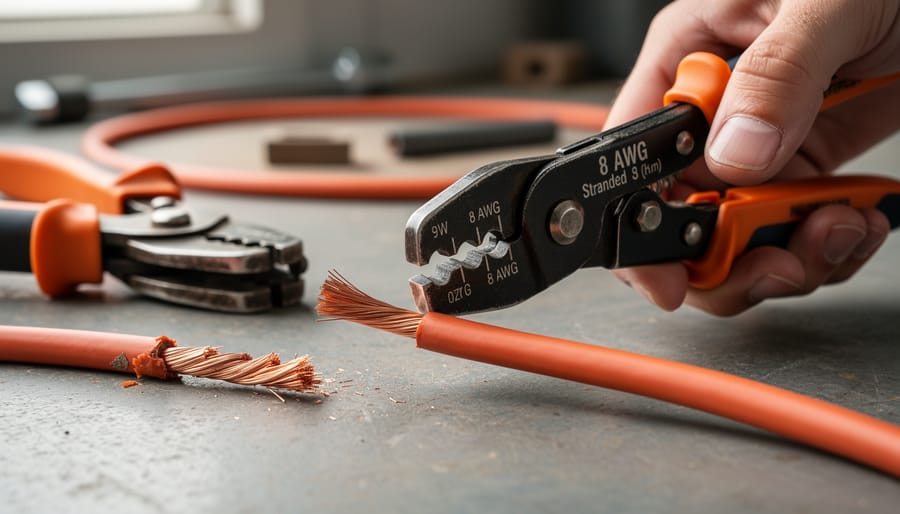
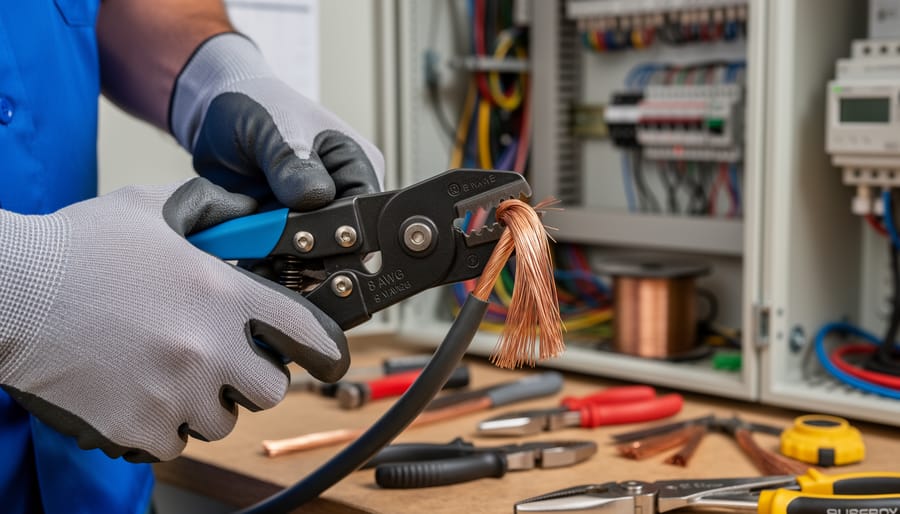
Reading the AWG Range: Rated for 8 AWG vs Merely Listed
A tool’s AWG range tells you what the jaws were built to handle, but where 8 AWG sits inside that range matters as much as whether it’s listed. Take the 6-12 AWG stranded multi-tool stripper/crimper: 8 AWG lands comfortably in the middle, so the jaw geometry is sized for it. Compare that to Knipex’s automatic stripper line, which is stated as stranded up to 8 AWG. It does the job, but 8 AWG is the ceiling, so there’s no wiggle room.
That distinction matters because stranded and solid ratings often differ. Stranded conductors are bulkier for their gauge and compress under the blades, so a tool may list one range for solid wire and a narrower one for stranded. Always read which figure applies to your wire.
Insulation is the other catch. Two 8 AWG cables can have very different jacket thickness, and thick-insulation cable (think battery or welding cable) can push a tool that tops out at 8 AWG past its limit. You may get a ragged cut, nicked strands, or a jaw that simply won’t close around the wire.
When a spec sheet is vague, it’s safer to size up. A tool rated well past 8 AWG, such as the 3 AWG to 16 AWG weottfiy listing, leaves headroom for fat insulation and awkward angles.
Depth Control, Leverage, and Comfort on Thick Conductors
Depth is where 8 AWG jobs usually go wrong. Thick insulation means you need a deeper, cleaner cut, but go even a little too far and the blade shears into the outer strands. Because the conductor is made of many fine strands, you often can’t see the damage until the wire is terminated and one lug barrel holds fewer strands than it should.
Preset-depth and self-adjusting designs take much of that guesswork out. A preset-depth cable stripper sets the cutting depth for a given conductor size, so every strip comes out the same. Self-adjusting strippers clamp the wire and open the jaws as you pull. That makes them forgiving, though it’s still worth confirming the stranded range covers 8 AWG with a little margin.
Leverage matters just as much. Thick copper resists the jaws, so longer handles give you more mechanical advantage and cut the squeeze force needed per strip. Short-handled multi-tools can feel strained on 8 AWG, even when the spec technically allows it.
Ergonomics becomes a real factor once you’re stripping dozens of runs in a day, such as a solar array, a battery bank or a subpanel feed. Padded or curved handles and a self-opening spring reduce hand fatigue. For a single weekend project, a basic tool is fine. For repetitive work, comfort is part of accuracy, because tired hands tend to over-squeeze and nick strands.
Types of Wire Strippers Compared for 8 AWG Stranded Work
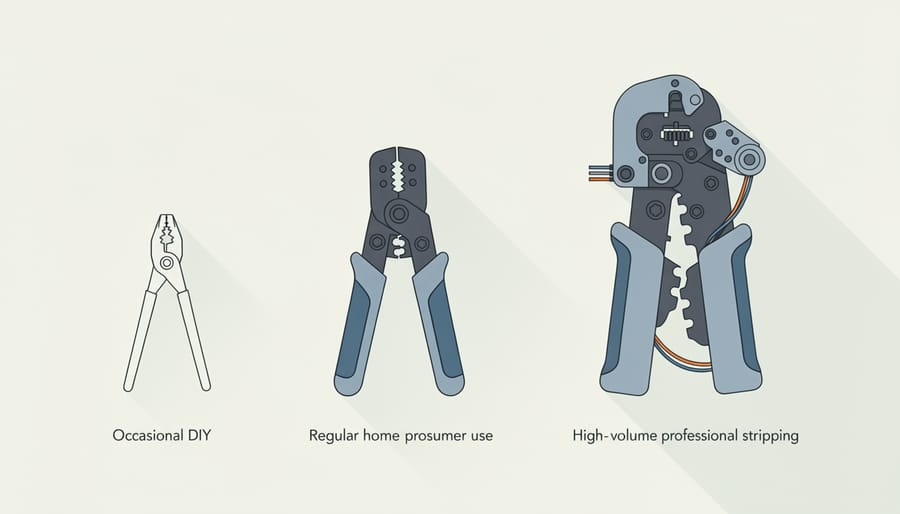
Not every stripper is built for 8 AWG stranded. The wide conductor, thick insulation, and dense bundle of strands punish tools designed for smaller gauges, so the tool family matters as much as any single model. If you also plan to terminate what you strip, our crimping tool guide covers the next step for heavy conductors.
| Tool type | Best use at 8 AWG stranded | Main strength | Main limitation |
|---|---|---|---|
| Self-adjusting / self-opening stripper | Occasional to frequent mixed-gauge work | No depth setting; fast and forgiving | Many models top out near or below 8 AWG |
| Forged heavy-duty manual stripper | Daily electrician use on thicker wire | Rugged build and strong leverage | Fixed notches mean checking the stranded rating |
| Combination strip/crimp/cut multi-tool | Occasional DIY and small repairs | One tool covers several jobs | Compromises on jaw size and leverage |
| Preset-depth cable stripper | Larger conductors and repeat cuts | Consistent depth protects strands | Bulkier; overkill for small wire |
| Powered / automatic machine | High-volume shops | Speed and repeatability | Size and cost of ownership; unnecessary for a few cuts |
Self-adjusting and self-opening strippers are the easiest to live with. Their jaws find the right depth on their own, which cuts down on nicked strands. The catch is range. Specs vary widely across the market: one 7-1/8-inch multi-tool stripper/crimper lists 6-12 AWG stranded, while a weottfiy tool is listed for 16 AWG to 3 AWG. Check that 8 AWG sits inside the stranded rating, not at its edge.
Forged manual strippers suit people who strip wire every day. The extra leverage on long handles makes thick conductors far less tiring, and they hold up to abuse. They generally trade the self-adjusting convenience for tougher construction.
Combination tools are the budget-friendly generalist. They strip, crimp, and cut, which is handy for car audio or a one-off repair, but their smaller jaws and shorter handles make 8 AWG a stretch. Many are rated below it, so verify first.
Preset-depth cable strippers shine on larger conductors, where setting the cut depth once and repeating it protects the copper. Powered machines only make sense when you’re processing many runs. For a handful of 8 AWG cuts, a good manual tool is the smarter choice.
Verified Picks at a Glance
Before the individual reviews, here is how the eight tools line up. Each one is covered with its customer rating and stock status as listed, and you won’t find prices or deals anywhere in this guide. Those details change too often to be useful, and we’d rather keep the focus on fit.
| Tool | Type | Customer Rating | Availability |
|---|---|---|---|
| Klein Tools 12075 | Forged, self-opening stripper | 5 out of 5 (34 ratings) | In stock |
| Klein Tools 11061 | 8-inch self-adjusting stripper/cutter | 4.6 out of 5 (10,582 ratings) | In stock |
| Klein Tools K12035 | Klein-Kurve heavy-duty stripper/cutter | 4.7 out of 5 (1,692 ratings) | In stock |
| Milwaukee 48-22-3079 | 6-in-1 stripping and reaming pliers | 4.8 out of 5 (2,381 ratings) | Limited stock |
| Klein Tools K12075 | Slim-forged, self-opening stripper | 4.7 out of 5 (156 ratings) | In stock |
| Wire Crimping tool | Strip, crimp, and cut multi-tool | 4.4 out of 5 (744 ratings) | In stock |
| AMZCNC Cable Stripper Tool 12 | Preset-depth cable stripper | 4.5 out of 5 (70 ratings) | In stock |
| Automatic Wire Stripping Machine | Electric heavy-duty stripper | 4.5 out of 5 (42 ratings) | Limited stock |
A quick word on reading these numbers. A rating from thousands of buyers carries more weight than a perfect score from a few dozen, so keep the sample size in mind as you compare.
One caution applies to every tool on the list. Ratings and stock status tell you how a tool is received, not whether it handles your wire. Before you buy, confirm that 8 AWG stranded conductor appears on the manufacturer’s spec sheet, ideally with some margin rather than right at the edge of the stated range.
Klein Tools 12075 Heavy-Duty Wire Strippers: Forged, Self-Opening Option

The Klein Tools 12075 is a forged, self-opening stripper with a built-in shear cutter and a straight handle. Self-opening means the jaws spring apart after each strip. On repetitive work, like prepping a bundle of runs, that saves a hand motion every time, and your grip stays settled instead of resetting between cuts.
It’s listed at 5 out of 5 from 34 customer ratings and shows as in stock. That’s a strong score, but 34 ratings is a small pool. A handful of unhappy buyers would move the number a lot, so treat it as an encouraging signal rather than proof, especially next to tools with thousands of reviews.
This tool suits electricians and serious DIYers who strip wire often and want a sturdy, no-frills hand tool. The forged build points toward durability, and the integrated cutter means one less tool on your belt. If you strip a few wires a year, the convenience matters less.
The key question is capacity. The listing data here doesn’t confirm that this model’s stranded range includes 8 AWG, and I can’t verify it. Before you buy, check the manufacturer’s spec sheet for the stranded rating specifically, and note whether 8 AWG sits comfortably inside the range or right at the edge. Thick 8 AWG stranded conductors are where a tool’s limits show up first, so confirm it rather than assume.
Klein Tools 11061 8-Inch Self-Adjusting Wire Stripper/Cutter: Proven High-Volume Favorite

The Klein Tools 11061 8-Inch Self-Adjusting Wire Stripper/Cutter earns attention mostly on the strength of its track record. It carries a 4.6 out of 5 rating from 10,582 customer ratings, and a sample that large says a lot about how it holds up across everyday jobs. When thousands of buyers land on the same score, you’re looking at a tool that works for a wide range of people, not a cult favorite for one narrow task.
The self-adjusting jaws are the main draw. Instead of picking the correct notch for each gauge, you close the handles and the tool grips the conductor and pulls the insulation free. That cuts guesswork, and it helps when you’re moving between different wire sizes on a job. On thicker stranded conductors, where a poorly matched notch can shear strands, taking the sizing decision out of your hands is a real advantage.
It’s currently listed as in stock, though availability can change, so confirm before you plan around it.
Here’s the catch for this guide. A big review count doesn’t tell you what gauge range the tool covers. Before buying for 8 AWG stranded work, check the stranded capacity on Klein’s spec sheet and make sure 8 AWG sits comfortably inside it, not at the very edge. If it does, this is a dependable pick for frequent, repetitive stripping.
Klein Tools K12035 Klein-Kurve Wire Cutters: Heavy-Duty Stripping With a Cutter’s Ergonomics

The Klein Tools K12035 Klein-Kurve takes a different approach from the other strippers in this guide. It’s built like a heavy-duty wire cutter, with a curved handle shaped for comfort, and it adds stripping capability. The curved profile matters most when you’re working through a lot of cable. Thick conductors like 8 AWG demand real squeezing force, and a handle that fits the palm cuts down on fatigue and hot spots. Electricians who strip and cut all day, installers pulling long runs, and anyone with a sore grip will get the most from that shape. For a one-off weekend job, the comfort advantage is less likely to matter.
Buyers have responded well. It carries a 4.7 out of 5 rating from 1,692 customer ratings, a solid sample, and it’s listed as in stock.
Before you commit, check the manufacturer’s spec sheet for the tool’s stated AWG range. The listing doesn’t confirm that 8 AWG stranded falls comfortably inside it, and stranded and solid ratings often differ. If 8 AWG sits at the edge of the range, or outside it, look at another pick. A tool this well reviewed is only a good match if it’s actually rated for the wire in your hands.
Milwaukee 48-22-3079 6-In-One Combination Wire Stripping & Reaming Pliers: Multi-Function Pick

The Milwaukee 48-22-3079 is a six-in-one pair of electrician’s pliers that combines wire stripping and reaming with other functions in one body. It has a 4.8 out of 5 rating from 2,381 customer ratings, which is a large sample and suggests it holds up well across a lot of real-world use.
Stock is tight. Only 1 is listed as left, with more on the way, so availability may change by the time you check.
The appeal of a combination tool is convenience. One pair of pliers can strip, ream and handle small jobs, so you carry less and switch tools less. The trade-off is specialization. A tool that does six things rarely strips as precisely on thick conductors as a dedicated stripper, and jaw notches built for common gauges can run out of room as wire gets heavier.
That matters for 8 AWG stranded. I can’t confirm from the listing data which gauges this tool’s stripping notches cover, so check the manufacturer’s spec sheet for an explicit stranded 8 AWG rating before you buy. If 8 AWG sits at the very edge of its range, or outside it, expect strand damage or a ragged strip. For comparison, other tools in this guide list their ranges openly, such as 6-12 AWG stranded on one multi-tool and 3 to 16 AWG on another.
This pick suits an electrician who wants one versatile tool for mixed everyday work, as long as the spec sheet confirms 8 AWG stranded support.
Klein Tools K12075 Heavy-Duty Wire Stripper: Slim-Forged Self-Opening Design

The Klein Tools K12075 is the slim-forged, self-opening stripper that often gets confused with the similarly named 12075. The two are separate listings, so check the model number before you order. The K12075 earns a 4.7 out of 5 from 156 customer ratings, and it’s listed as in stock.
The slimmer profile is the main reason to consider it. Narrower jaws and a leaner head fit into crowded junction boxes, panel gutters, and tight conduit bodies where a bulkier tool just won’t turn. The self-opening action springs the handles apart after each cut, which saves effort on repetitive work. A built-in shear cutter handles quick trims without switching tools.
The 156-rating sample is much smaller than the counts behind some other Klein listings, so treat the score as encouraging rather than definitive.
Here’s the catch for this guide: nothing in the verified data confirms the K12075’s stranded capacity at 8 AWG. Before buying, find the stranded range on the manufacturer’s spec sheet and make sure 8 AWG sits comfortably inside it, not at the edge. Thick insulation on 8 AWG cable leaves little margin. Strip a test length and inspect the strands for nicks or splayed ends. If you’re brushing up on wire quality basics or learning to wire a wall jack that same clean-strip habit applies.
Wire Crimping tool Wire crimper: Budget-Minded Strip, Crimp, and Cut Multi-Tool

The multifunctional stripper, crimper, and cutter from the “Wire Crimping tool” listing is the budget-minded option in this lineup, and it earns its place only if you read the fine print. It’s rated 4.4 out of 5 from 744 customer ratings and is listed as in stock, so plenty of buyers have put it to work on real jobs.
Here’s the catch for this guide: the listed range is 22-10 AWG. That puts 8 AWG stranded outside what the tool is built to handle. Forcing thick 8 AWG conductor into jaws sized for 10 AWG or smaller is a good way to nick strands or leave a ragged strip, so treat this as a tool for lighter wire rather than a stand-in for a true 8 AWG stripper.
Within its range, it does what its description promises: stripping, crimping, and cutting for insulated, bare, and heat-shrink connectors in a single pair of pliers. One thing to plan for is that no connectors are included, so you’ll need to buy the terminals separately and match them to the wire gauge. If you’re curious how crimp work translates to larger systems, our explainer on solar connector crimping covers the basics.
Who is it right for? A hobbyist or DIYer working mostly with 10 AWG and thinner wire, such as small 12V projects, who wants one compact tool instead of three. If your main job is 8 AWG stranded, look to the preset-depth or heavy-duty picks elsewhere in this guide.
AMZCNC Cable Stripper Tool 12: Preset-Depth Stripper for Larger Conductors

The AMZCNC cable stripper is built for the thick end of the wire spectrum. Its listing covers 12 to 4/0 AWG, so 8 AWG stranded sits comfortably inside the range rather than at the edge, which is exactly what you want when buying for this job.
What sets it apart is the preset-depth design. Instead of asking you to judge how far the blade should bite, the tool fixes the cutting depth for you. On heavy stranded conductors, that matters. A blade that goes too deep slices through outer strands, and one that doesn’t go deep enough leaves insulation clinging to the copper. A preset depth takes most of that guesswork out and helps protect the conductor, which is the reason it’s marketed around “no guessing, no copper damage.”
Customers have rated it 4.5 out of 5 across 70 customer ratings. That’s a solid score, though the sample is modest compared with the best-selling hand strippers, so treat it as a good sign rather than proof. It’s currently listed as in stock.
This tool makes the most sense if you regularly work with larger-gauge cable, such as battery runs, solar wiring, or subpanel feeds, and you value repeatable results over a do-everything gadget. It’s a dedicated stripper, so don’t expect crimping or cutting extras. Before you buy, confirm the supported range and any stranded-wire notes on the manufacturer’s spec sheet.
Automatic Wire Stripping Machine: Electric Option for High-Volume and Large Cable

The StripMeister E1000 is an electric, industrial-grade stripper built for copper and aluminum cables up to 1-3/4 inches, with a jam-free design. It sits at the opposite end of the market from a hand stripper. Customers give it 4.5 out of 5 from 42 customer ratings. That’s a smaller sample than the big-volume hand tools in this guide, so read it as a good sign rather than a settled verdict. Availability is listed as only 11 left in stock, with a prompt to order soon, so stock may shift.
Who actually needs a machine like this? Shops that strip many runs in a day, such as cable assembly benches, battery and solar installers prepping long bundles, or anyone processing large-diameter cable in volume. The value is consistency. Every strip is the same, your hands aren’t fighting thick insulation all afternoon, and a machine rated for cable up to 1-3/4 inches has plenty of headroom above 8 AWG.
For a single 8 AWG run, though, it’s overkill. You’d be buying and storing industrial equipment for a job a hand tool with the right range handles in seconds. A machine also doesn’t remove the need to check that your conductor type and size fall within its stated capability, so confirm that on the manufacturer’s spec sheet before ordering.
If you strip a few conductors a month, look at the hand options elsewhere in this guide. If stripping is part of your daily workflow, this is the one that earns its bench space.
Matching a Tool to Your 8 AWG Project: Recommendations by Use Case
Your best pick depends on how often you strip and what else the job demands. Here’s how the eight roster tools map to real scenarios, using only their listed ratings.
- Daily electrician use: the Klein Tools 11061 8-Inch Self-Adjusting Stripper/Cutter, backed by a 4.6 out of 5 rating across 10,582 customer ratings.
- Comfort over long shifts: the Klein-Kurve K12035, rated 4.7 out of 5 from 1,692 ratings.
- Tight spaces: the slim-forged Klein Tools K12075, rated 4.7 out of 5 from 156 ratings.
- Multi-function convenience: the Milwaukee 48-22-3079 six-in-one pliers, rated 4.8 out of 5 from 2,381 ratings.
- Preset-depth precision on larger cable: the AMZCNC Cable Stripper, rated 4.5 out of 5 from 70 ratings.
- High-volume production: the StripMeister E1000 machine, rated 4.5 out of 5 from 42 ratings.
Be honest about the caveats, though. Most of the hand tools above need their stranded 8 AWG capacity confirmed on the manufacturer’s spec sheet, since the roster lists no verified 8 AWG rating for them. The AMZCNC’s listed 12 to 4/0 AWG range covers 8 AWG, which makes it the most clear-cut fit on paper.
The Wire Crimping tool, listed at 22-10 AWG, doesn’t cover 8 AWG at all, so skip it for this gauge. For a home or DIY user stripping a few runs a year, a verified-range hand tool beats a machine every time. Treat the Klein 12075, with a perfect 5 out of 5 from only 34 ratings, as promising but thinly tested.
Common Mistakes to Avoid When Stripping and Choosing for 8 AWG Stranded
Most 8 AWG stripping problems trace back to a handful of avoidable mistakes, and almost all of them start before the tool touches the wire.
Buying on the headline range alone. A tool may advertise a wide AWG span but rate it differently for stranded and solid conductors. Prevention: find the stranded rating specifically. A listing like “6-12 AWG stranded” tells you 8 AWG is covered, while a vague “up to 8” does not.
Picking a tool where 8 AWG sits at the edge. A jaw working at its maximum capacity struggles with thick insulation and leaves little margin. Prevention: choose a tool whose range clearly brackets 8 AWG, such as one rated 3 to 16 AWG, so the jaw isn’t stretched.
Trusting a perfect rating from a tiny sample. A 5.0 from a few dozen reviews says far less than a 4.6 from thousands. Prevention: weigh the review count alongside the score.
Using the wrong notch. Combination tools often have strip and crimp notches sized for lighter gauges. Forcing 8 AWG into one chews up strands or leaves a weak crimp. Prevention: confirm the specific notch is rated for your gauge, and skip it if it isn’t.
Cutting too deep. Over-penetrating the insulation slices outer strands. Prevention: set the depth before you strip, test on a scrap piece, and use a preset-depth or self-adjusting design when you can.
Ignoring damaged strands. This is the costly one, because the damage isn’t always visible at a glance.
Prevention: inspect every stripped end, and if you see severed strands, cut back and start again rather than hoping it holds.
8 Gauge Stranded Wire Stripping Tool FAQs
Can any wire stripper handle 8 AWG stranded wire?
No. Many everyday strippers top out below 8 AWG, so check that the printed range explicitly covers it. For example, one multi-tool listing is rated for 6-12 AWG stranded, while a different tool’s listing covers 3 AWG to 16 AWG.
Do I need a different tool for stranded versus solid wire?
Not always, but ratings can differ between the two, so confirm the stranded range specifically. Stranded conductors splay and shear more easily, which makes accurate jaw sizing matter more.
Is a self-adjusting stripper good enough for 8 AWG?
It can be, provided its stranded range includes 8 AWG with some margin. Self-adjusting jaws reduce guesswork, but they still need to be rated for the conductor and insulation thickness you’re working with.
What’s the best way to avoid cutting strands?
Use a tool whose jaw or preset depth matches the conductor, and strip with steady, controlled pressure instead of squeezing hard. If you see nicked strands, cut back and start again rather than installing a damaged end.
When is a powered stripping machine worth it?
When you’re stripping many runs or large cable in volume, such as in a shop. For occasional 8 AWG jobs, a well-matched hand tool is simpler and far more practical.
Whichever route you take, finish the job properly. Reaming or crimping isn’t required after every strip, but if the end is going into a lug or connector, make sure the stripped length fits it and the strands are tidy and intact before you terminate.
The right 8 gauge stranded wire stripping tool comes down to three checks. First, confirm the stranded 8 AWG rating on the manufacturer’s spec sheet, and look for a tool where 8 AWG sits comfortably inside the range instead of at its edge. A tool listed for 6-12 AWG stranded or 3 AWG to 16 AWG has real margin. One that tops out at 8 AWG leaves you little room for thick insulation.
Second, favor controlled depth and good leverage. Self-adjusting jaws and preset-depth designs protect the strands, and a comfortable, longer handle saves effort when you’re stripping run after run.
Third, match the tool type to your workload. An occasional DIY job rarely justifies a powered machine, while a shop stripping dozens of cables a day probably does. A multi-tool is convenient, but only if its stripping range actually reaches 8 AWG.
Direct Cables keeps these reviews unbiased and free of affiliate links, so the tradeoffs here are the ones that matter in the field. Before you buy, read the spec sheet, confirm stranded support for your gauge, and choose the tool that fits how you actually work.